Yunnan / YN_C2
Yunnan — A Word Grown from the Tea Forest
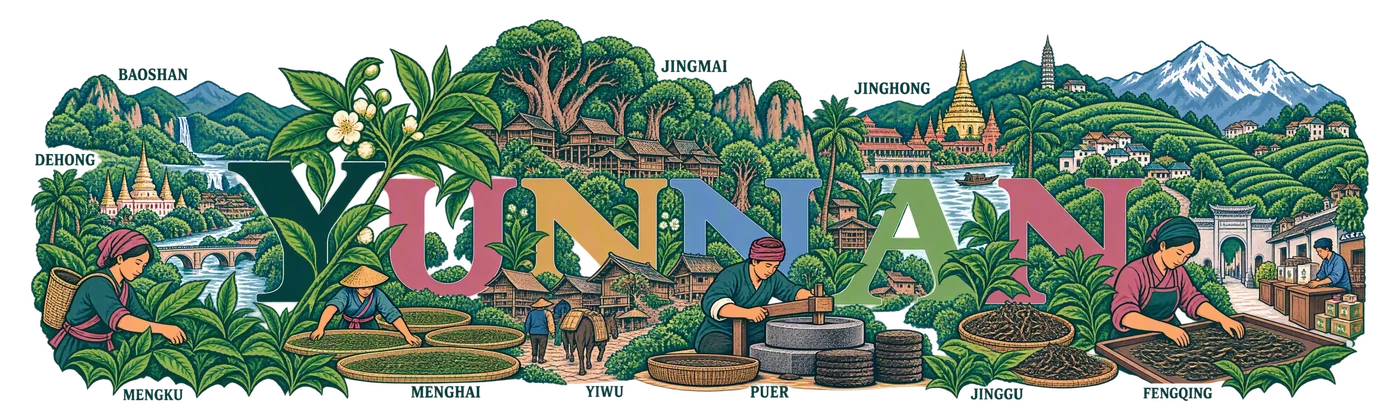
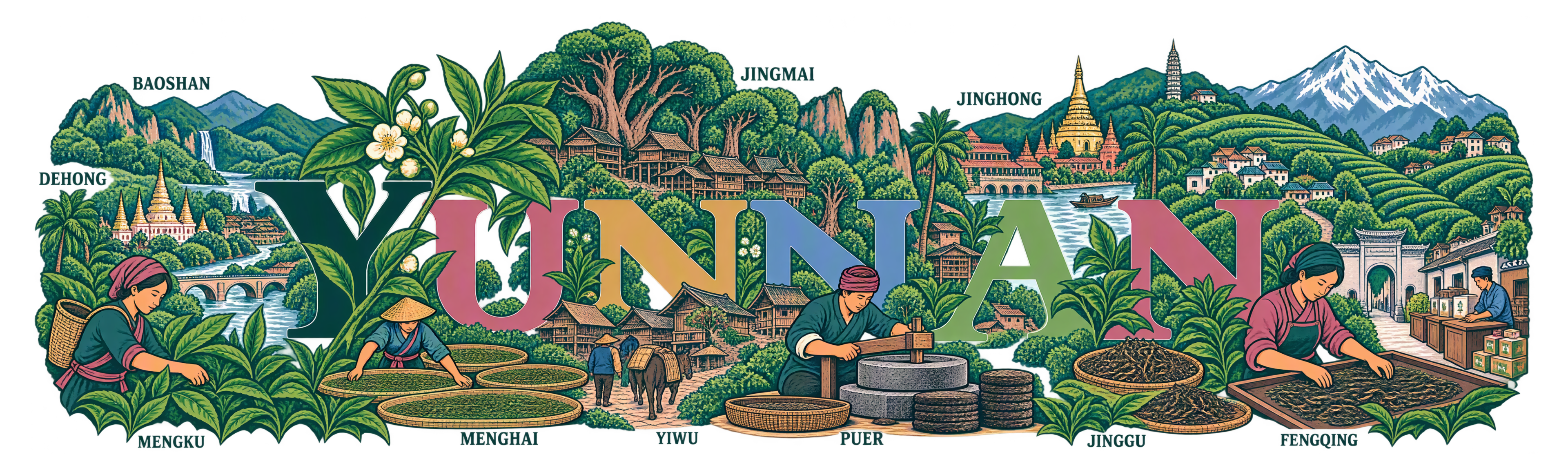
YUNNAN includes real hands, forest branches and pressing; the letters remain legible.
Checked for publication · Drawing review and technical check of the current file
Review basis
YUNNAN is read in full and works as a large colored base. Tea trees, picking, drying, pressing and trade are drawn cleanly; regional names are legible, with no visible cropping or rectangular backing.
PNG RGBA 3840 × 1152 px; real alpha channel; proportional export 250 × 75 mm.
Approved after review for the open gallery; does not imply the user's endorsement of industrial production.
Creative brief palette
#174E47
#BD597E
#7AA361
#D3A353
#658CBB
Original generation prompt
Text matches the public TXT. The list of inscriptions and details describes the author's brief; this is not OCR and not a promise of reproducibility without the references used.
SHA-256: 222b89cc88b2221eeb1540ed8bb3876877d46a27083c4482c7a5ab0382ff0ea6
Read the full prompt
Create an original collectible regional ceramic PRINTING DECAL, not a mug or mockup. The supplied image is a drawing/style benchmark only: replace every reference-region subject and word with the researched region described below. Make a confident, rewarding composition whose tea craft, architecture and landscape belong together.
OUTPUT: PNG RGBA, native 3840 x 1280 px. Keep every mark inside x=60..3780 and y=110..1170; use nearly the whole long strip. The final export is 3840 x 1152 px for 250 x 75 mm. Do not shrink the entire design to a central 16:9 picture. Preserve normal object proportions and complete edge objects.
ALPHA: genuine transparent exterior and natural transparent openings inside the drawing. No white or cream rectangle, paper texture, sky wash, sea fill, provincial silhouette, checkerboard, aura, gradient or drop shadow. Unpainted architecture, water and negative openings reveal alpha. Colour belongs to actual drawn objects, never a vague backdrop. Do not reproduce any opaque field visible in the reference.
For C1–C6, create ONE connected varied panorama with two or three unequal anchors, overlapping near/middle/far scales and smaller discoveries. Connect through real terrain, streets, roofs, branches and human actions, not dotted diagram routes. No two-row sticker sheet, isolated equal scenes, caption boxes, repetitive generic gardens or an empty band under the title. Do not impose a percentage of blank space. C7 instead follows its explicit irregular album direction below.
English lettering only, exact spelling, dark clear capitals for allowed captions. One main regional title. No Chinese characters, logos, invented seals, pseudo-writing, promotional superlatives or health claims. A short legible caption is preferable to microscopic text. Respect the stated distinctions between growing tea, processing it, trading it and serving it. A full research inventory need not become a printed gazetteer.

COLLECTION: A LIVING REGIONAL WORD. Follow the supplied GD22 reference: a monumental original serif region name interlocks with illustrated tea life. Make each letter instantly legible. Roofs tuck under terminals, branches overlap selected edges, people work at letter bases, and regional landforms flow between counters. Crisp decorative pen illustration and selective five-colour accents, never a painting pasted inside letters.
REGION: YUNNAN.
PALETTE: #174E47, #BD597E, #7AA361, #D3A353, #658CBB. Preserve this regional colour family; first colour supplies the strongest contour/text. Extra dark/light rendering colours and full-colour watercolour are not wanted.
RESEARCHED CONTENT:
Differentiate Yunnan's tea ecologies and processes. Southwest Xishuangbanna includes Menghai with Bulang, Nannuo and Bada: large-leaf tea branches, a maker sun-drying leaves and a stone cake press. Yiwu/Mengla has village roofs and a tea-carrying path, distinct from Menghai. Jinghong provides another southern garden/processing cluster. Jingmai/Lancang must show tea trees growing beneath a varied forest canopy beside modest village buildings, not clipped monoculture rows. Simao/Ning'er in Pu'er carries a sorting and pressing workshop; Jinggu/Jingdong has inland tea hills and a loose-leaf tray. Lincang's Shuangjiang/Mengku and Yongde have arbor-tea branches and a plucking hand. Fengqing Dianhong is a separate black-tea story: long twisted leaves and buds on a rolling/sorting table, not a stack of Pu'er cakes. Baoshan/Changning/Tengchong and Dehong form western tea valleys. Dali/Nanjian has actual tea hills, whereas a small Xiaguan packing counter and Kunming table express processing/trade. Use twelve macro territories but only ten labels; small neighbours may share a locally plausible scene. Northern snow mountains are a distant travel context, never tropical growing ground. Show large leaves, sun-drying, rolling and pressing with distinct readable tools.
AUTHORED COMPOSITION:
Make the six-letter YUNNAN a bold original serif structure. An arbor branch reaches above Y and U, while Jingmai village eaves rest near the first N; open letter counters remain visibly transparent. A stone cake press and a kneeling maker sit before the central double-N area, never replacing the letter stems. Along the right letters, Fengqing long twisted leaves rest on a rolling table and a Lincang picker follows a slope. Small Yiwu caravan roofs and Menghai drying mats occupy a shared lane at the letter feet; western valleys and a Nanjian tea slope are secondary discoveries. Use the five specified inks as clean leaf, roof, mat and tool accents. Avoid green scenic paintings inside the word and ensure the dark tea captions remain readable.
LETTERING PLAN:
YUNNAN once. Supporting tea captions only: MENGHAI, YIWU, JINGHONG, JINGMAI, PUER, JINGGU, MENGKU, FENGQING, BAOSHAN, DEHONG. Nanjian/Xiaguan scenes remain unlabelled rather than extra tiny text.
REGIONAL SAFEGUARDS:
Jingmai is forest-understorey tea, not regimented clipped terraces. Fengqing Dianhong is black tea; Pu’er cakes do not replace every regional tea. Hani terraces grow rice, not tea. Snowy Shangri-La/Jade Dragon is travel context, not a tropical tea estate. Do not merge the three parallel rivers. No invented ethnic costume, giant ancient-age labels, brand wrappers or medical claims.
FINAL STANDARD: sharply drawn object edges, deliberate line hierarchy, vivid meaningful local differences and a recognisable whole place. Protect the main title and key silhouettes; never solve complexity by making everything equally tiny.