Guangdong / GD_C7
Guangdong — Tea Province
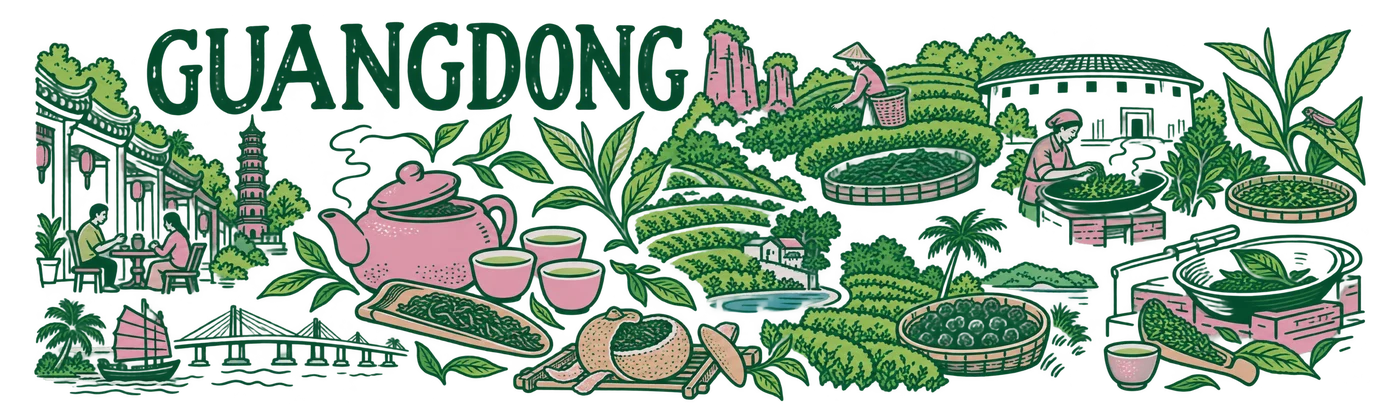
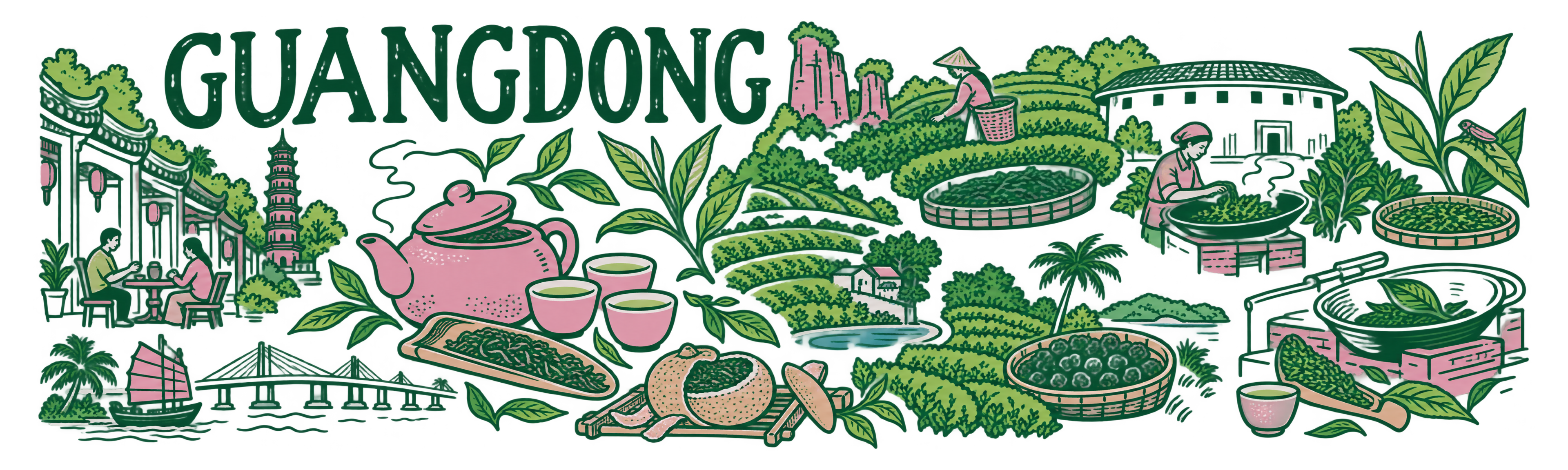
Tea gardens and leaf processing, Xinhui citrus peel, urban gongfu, and the Pearl River: large green-pink objects in a tourist outline drawing.
Approved for publication · C7: fresh review of the drawing and technical check
C7: drawing method and real style references
Factual basis and choice of subjects
In Guangdong, tea territories and leaf processing become the main content. The scenes are selected from the source map and the previous study of thirteen macro-territories; several neighboring zones are combined into large thematic groups.
Distinguished are Fenghuang/Raoping, Yingde, Renhua/Shaoguan, Meizhou, Heyuan/Zijin, Huizhou/Jieyang, the western belt and Lianjiang. Xinhui is shown through citrus peel and processing: this is not a claim about local pu'er cultivation. Guangdong gongfu is conveyed through utensils and people's actions.
Leaf, basket, wok, citrus peel, tea bush and ship provide different silhouettes. The map context is complemented by Danxia, Lingnan architecture, a bridge and a river vessel. The combined scene does not indicate the exact address of a farm or the co-location of all items.
Title and drawing language
The assignment provides only one word — GUANGDONG, in large Latin serif letters. Small toponyms, Chinese text, numbers and third-party logos are excluded. This is a description of the assignment; actual legibility is assessed separately.
Narrative inventory of the original concept
Below are the planned groups from the English author's prompt, quoted verbatim. This is a transparent explanation of the choice of subjects, not a promise that the generator reproduced every detail.
1. A generous foreground gongfu still life: a small rounded clay teapot with its lid slightly lifted, exactly three little tasting cups, a narrow bamboo scoop with long twisted loose tea leaves. The teapot outline stays open and light, with selective rose or celery accents. This is the broad human-scale heart of the artwork.
2. Fenghuang and Raoping as two neighbouring miniature tea landscapes, drawn as one memorable eastern-tea group: a tall gnarled tea bush on a rocky slope with long branching leaves, and beside it lower curved rows with two broad bamboo withering trays. Do not draw a mythical phoenix, add age numbers or give the two places identical bush silhouettes. A few long twisted leaves can sit beside the group.
3. Yingde's northern black-tea country: a compact rolling tea garden with one picker holding a basket of buds, and a small shallow bamboo tray with loosely curled processed leaf in the foreground. The terraces are a few gently arcing rows, not a giant painted mountain backdrop.
4. Renhua/Shaoguan: a separate slender Danxia rock-pillar silhouette and a large tender tea shoot with pale unprinted bud interiors, joined locally by two plant lines. The geography and bud shape matter; do not label the product white tea merely because the buds look downy.
5. Meizhou's Hakka tea culture: a clean half-view of a traditional enclosed Hakka courtyard with tiled eaves, a nearby small tea garden, and a person hand-firing leaves in a shallow wok. Enlarge the wok enough that the loose leaves are readable. An intimate rural episode rather than a giant fortress.
6. Heyuan/Zijin: one elegant tea branch with a small wedge-shaped leafhopper resting on a leaf, paired with a little rolling/withering tray. The insect is small but recognizable, not a cicada, bee or butterfly. No honeycomb or honey being poured into tea.
7. Huizhou and Jieyang's pan-fired tea traditions: a low domestic tea-work counter, broad open wok, bamboo scoop and green leaf. Distinguish this close object group from the Hakka courtyard scene; no second full building or repeated picker.
8. Xinhui: an oversized opened mandarin peel shell containing dry tea leaf, its round cut lid leaning beside it, plus several curved peel strips resting on a light bamboo drying rack. This is citrus-peel tea processing; no Pu'er trees, no fruit juice glass and no locally grown Pu'er claim.
9. The western tea belt of Zhaoqing, Yunfu and Maoming: a compact fan of sloping tea terraces ending at a basket, with a short river bend and one simple rural roof. A single varied growing landscape represents the western belt without pretending to locate every farm. No elephants or exotic invented tea species.
10. Lianjiang in the southwest: a separate low tea-garden ridge, a shallow basket of rounded rolled oolong leaves, and a modest coastal palm off to one side as a regional landscape cue. Tea rows remain inland; do not place bushes in beach sand.
11. A warm Guangzhou city episode: a short arcade street with recognizably Lingnan tiled rooflines and a slender pagoda silhouette, plus a small seated pair sharing tea under the arcade. Keep the architecture mostly unfilled and medium-outlined. It is a compact recognizable urban counterweight, not a continuous skyline. No Hong Kong or Macau landmark borrowed from the other reference photos.
12. Pearl River/coast: a graceful short bridge fragment on piers, a small traditional junk with a clearly ribbed sail, and two short wavy water lines. Most water is completely transparent. Keep this local scene light; the bridge does not become a border or connector across the entire picture.
Drawing method and style references
Photographs of real tourist mugs with city scenes of Guangzhou, Macau, Hong Kong and Zhuhai were studied. From them, observed drawing features were taken: medium lively hand outline, simple recognizable silhouettes, selective flat color accents and a large title in the upper band. The specific set of viewed angles varied by region.
Local scenes vary in scale, shape, and height. Their juxtaposition creates an overall rhythm; a continuous panorama, a shared horizon, a grid of identical modules, and a fixed percentage of empty space are not imposed. Transparency is preserved between and within outlines.
The ceramic surface, highlights, hands, and the object background of the photographs are not part of the new drawing. Reference images and personal source photos are not published here. The three colors of each region are the author's palette, not a measured paint standard of the photographed cup.
Review basis
Fresh review of the root and independent critique of Shanghai: GUANGDONG is legible, outlines and edges are intact, the tea subject is evident, the background between scenes is transparent. The drawing is approved for display.
PNG RGBA 3840 × 1152 px; real alpha channel; proportional export at 250 × 75 mm.
Reviewed for display as an additional C7 pilot; does not imply user approval of the print run. Rows and foliage in the center are denser than references; a separate reading of all 13 tea territories is not claimed.
Creative brief palette
#165641
#B1C761
#D69AAA
Original generation prompt
Text matches the public TXT. The list of inscriptions and details describes the author's brief; this is not OCR and not a promise of reproducibility without the references used.
SHA-256: 979b612044ae10fb3cbf0976b79e98b3a1e47d491f25df6f23aef6df0c8e7752
Read the full prompt
Create an original GUANGDONG souvenir illustration: only flat unwrapped artwork, intended for a 250 x 75 mm tea cup print. Study the supplied real tourist-cup photographs as the primary and decisive visual reference. Match their friendly medium-weight hand-drawn outlines, open unpainted interiors, selective flat pastel accents, playful changes of scale and little local scenery episodes. Make fresh Guangdong drawings, never reproduce the cup photographs or their logos. There is no cup, handle, cylindrical distortion, hand, room, shadow or mockup in the output. This is a new drawing in that close visual language, not an intricate antique atlas, realistic painting, dense engraving, vector icon pack or collage of labelled badges.

CANVAS AND TEXT
Native carrier: 3840 x 1280 transparent RGBA PNG. Compose a wide print strip occupying nearly the entire width and the middle 1120 pixels of height; keep at least 80 truly transparent pixels above and below, and 40 at either side. All marks stay inside the canvas. The export will be proportional, without distorting any object, onto 3840 x 1152 pixels. Do not depict measurements or technical guides.
The sole visible text is exactly GUANGDONG, once, in large confident uppercase souvenir serif letters, dark forest green with a few unfilled worn flecks. Put it across one substantial upper-left-to-middle portion, as the city name on the reference mugs; it must not become a full-width masthead. Nine clearly formed letters. No Chinese, other place names, micro-labels, slogans, dates, numbers or logos anywhere. All baskets, chests, signs and containers remain unlettered.

THE THREE-INK LOOK
Dark forest green #165641 for the outlines and headline, mellow celery green #B1C761 and dusty rose #D69AAA for selected interior accents. Limit the artwork to these three colour families and transparency. No black, brown, yellow or white underpaint. Medium human pen lines, lively but controlled, with small irregularities, a few widely spaced hatching strokes or little stippled marks. Most walls, boats, leaves and vessel bodies are only outlined. Some leaf planes, roof patches, petals, tea surfaces and mountain facets receive small flat fills. Use the original photographs' clarity and easy charm: not fine scratchy illustration or shading built from thousands of lines. Antialias naturally, but do not add gradients, glossy lighting, watercolor clouds, paper grain or a sepia field.

STORY: A PROVINCE UNDERSTOOD THROUGH TEA
Tea must occupy most of the storytelling. Guangdong includes several distinct growing and processing cultures, not only one famous Dancong mountain. Weave the following subjects into approximately twelve unequal illustrated groups. They are an unlabelled artistic regional anthology, not a literal scale map. Combine neighbouring related subjects where described. A few large shapes anchor the strip; smaller scenes tuck into their irregular open pockets. Tea plants are recognizable branching bushes with pointed serrated leaves, never rice fields or coffee cherries.

1. A generous foreground gongfu still life: a small rounded clay teapot with its lid slightly lifted, exactly three little tasting cups, a narrow bamboo scoop with long twisted loose tea leaves. The teapot outline stays open and light, with selective rose or celery accents. This is the broad human-scale heart of the artwork.
2. Fenghuang and Raoping as two neighbouring miniature tea landscapes, drawn as one memorable eastern-tea group: a tall gnarled tea bush on a rocky slope with long branching leaves, and beside it lower curved rows with two broad bamboo withering trays. Do not draw a mythical phoenix, add age numbers or give the two places identical bush silhouettes. A few long twisted leaves can sit beside the group.
3. Yingde's northern black-tea country: a compact rolling tea garden with one picker holding a basket of buds, and a small shallow bamboo tray with loosely curled processed leaf in the foreground. The terraces are a few gently arcing rows, not a giant painted mountain backdrop.
4. Renhua/Shaoguan: a separate slender Danxia rock-pillar silhouette and a large tender tea shoot with pale unprinted bud interiors, joined locally by two plant lines. The geography and bud shape matter; do not label the product white tea merely because the buds look downy.
5. Meizhou's Hakka tea culture: a clean half-view of a traditional enclosed Hakka courtyard with tiled eaves, a nearby small tea garden, and a person hand-firing leaves in a shallow wok. Enlarge the wok enough that the loose leaves are readable. An intimate rural episode rather than a giant fortress.
6. Heyuan/Zijin: one elegant tea branch with a small wedge-shaped leafhopper resting on a leaf, paired with a little rolling/withering tray. The insect is small but recognizable, not a cicada, bee or butterfly. No honeycomb or honey being poured into tea.
7. Huizhou and Jieyang's pan-fired tea traditions: a low domestic tea-work counter, broad open wok, bamboo scoop and green leaf. Distinguish this close object group from the Hakka courtyard scene; no second full building or repeated picker.
8. Xinhui: an oversized opened mandarin peel shell containing dry tea leaf, its round cut lid leaning beside it, plus several curved peel strips resting on a light bamboo drying rack. This is citrus-peel tea processing; no Pu'er trees, no fruit juice glass and no locally grown Pu'er claim.
9. The western tea belt of Zhaoqing, Yunfu and Maoming: a compact fan of sloping tea terraces ending at a basket, with a short river bend and one simple rural roof. A single varied growing landscape represents the western belt without pretending to locate every farm. No elephants or exotic invented tea species.
10. Lianjiang in the southwest: a separate low tea-garden ridge, a shallow basket of rounded rolled oolong leaves, and a modest coastal palm off to one side as a regional landscape cue. Tea rows remain inland; do not place bushes in beach sand.
11. A warm Guangzhou city episode: a short arcade street with recognizably Lingnan tiled rooflines and a slender pagoda silhouette, plus a small seated pair sharing tea under the arcade. Keep the architecture mostly unfilled and medium-outlined. It is a compact recognizable urban counterweight, not a continuous skyline. No Hong Kong or Macau landmark borrowed from the other reference photos.
12. Pearl River/coast: a graceful short bridge fragment on piers, a small traditional junk with a clearly ribbed sail, and two short wavy water lines. Most water is completely transparent. Keep this local scene light; the bridge does not become a border or connector across the entire picture.

LAYOUT AS ON THE ACTUAL CUPS
The headline, broad gongfu vessels, gnarled tea bush and the tall rock/pagoda are the strongest silhouettes. Let small figures, baskets, citrus curves, leaf forms, eaves and local terrain weave between them. Mix upper and lower positions and unequal baseline heights. Objects near each other have complementary shapes and pleasant close spacing, while their contours stay legible. Some groups are one object, others tiny scenes, exactly as the references. Avoid an evenly spaced sticker sheet, two rigid rows, uniform circles or boxes. Avoid a large barren middle. Equally avoid turning all the scenes into one continuous landscape or covering the strip with coloured hills. A handful of objects may locally overlap within a scene, never all piled onto the same silhouette.
The viewer should recognize a lively tourist cup drawing instantly, then discover genuine tea details on closer inspection. The overall amount of detail is moderate and readable at 250 mm wide: simplify architecture and plants rather than miniaturizing dozens of elements. No decorative route dots, arrows, star confetti, steam ribbons, border frames, unrelated foods or generic repeated cup filler.

GENUINE TRANSPARENT PRINT
Only drawn ink marks and their small chosen accent fills are present. All untouched spaces between subjects and inside open objects are alpha zero. No white rectangle, white sticker silhouette, simulated ceramic background, checkerboard drawn into the image, translucent paper layer, broad landscape wash, sky or sea field. In particular, the space around the title, beneath bridge arches, between branches and inside unfilled vessel outlines remains truly transparent. Produce one finished complete strip, without any presentation layout.