广东 / GD_C7
广东——茶乡
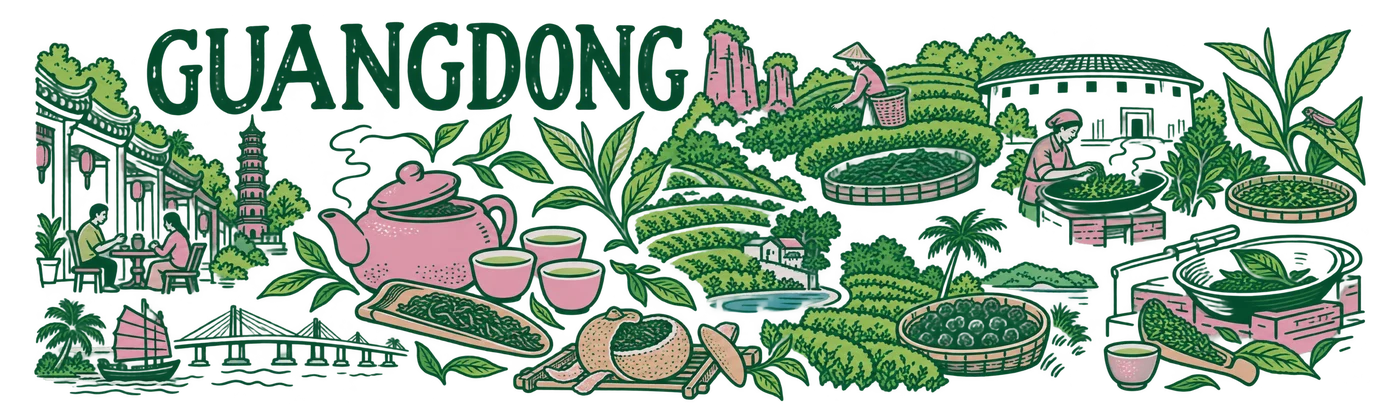
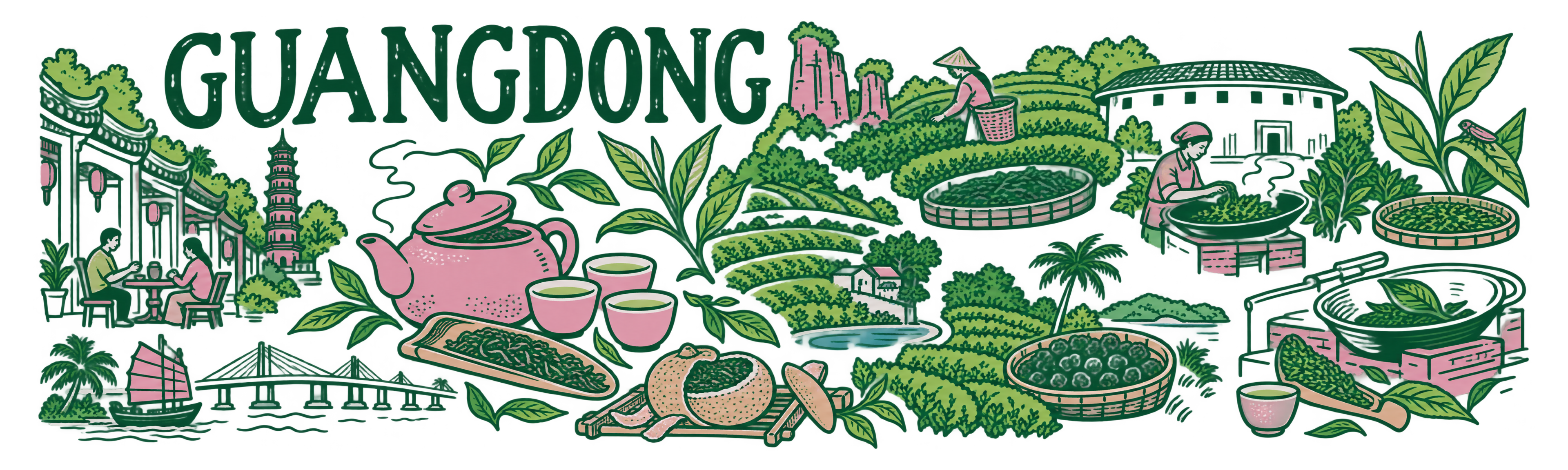
茶园与制叶、新会陈皮、城市工夫茶与珠江:旅游线描中大型绿粉物件。
已审核可发布 · C7:重新查看图稿并进行技术检查
事实依据与题材选择
在广东,茶区和茶叶加工成为主要内容。主题选自原始地图和此前对十三个宏观区域的研究;几个相邻区域被合并为大型主题组。
区分Fenghuang/Raoping、英德、Renhua/Shaoguan、梅州、Heyuan/Zijin、Huizhou/Jieyang、西部地带与廉江。新会通过柑皮与加工呈现:并非声称当地种植普洱。广东工夫茶以器具与人物动作传达。
茶叶、篮子、炒锅、柑橘皮、茶树与船只呈现不同剪影。丹霞、岭南建筑、桥梁与内河船补充了地图背景。组合场景并不标示茶场的精确地址或所有物品的共处位置。
图名与图语
任务中仅规定一个词——GUANGDONG,采用带衬线的大号拉丁字母。小地名、中文文本、数字和第三方标志均被排除。此为任务描述;实际可读性另行评估。
原始构思的情节清单
以下逐字列出英文作者提示中计划的组别。这是对选题的透明解释,而非承诺生成器复现了每个细节。
1。前景是宽大的功夫茶静物:一把圆润的小紫砂壶,壶盖微启,恰好三只小品茗杯,一把窄竹茶则,盛着长而卷曲的散茶。茶壶轮廓保持开放轻盈,点缀玫瑰色或芹菜色。这是作品宽宏的人文尺度核心。
2。凤凰与饶平作为两个相邻的微型茶景,绘制成一个令人难忘的东部茶组:一株高大虬曲的茶树生长在岩石坡上,叶片细长伸展,旁边是低矮弯曲的茶行和两个宽大的竹制萎凋盘。不要绘制神话中的凤凰,不要添加树龄数字,也不要让两地茶树轮廓完全相同。茶组旁可放置几片长而扭曲的茶叶。
3。英德北部红茶产区:紧凑起伏的茶园,一名采茶工手持一篮茶芽,前景有一个装有松散卷曲加工叶的小浅竹盘。梯田是几条平缓的弧形茶行,而非巨大的绘画式山景背景。
4。Renhua/Shaoguan:一个独立的细长丹霞岩柱剪影和一个带有浅色未印刷芽心的大型嫩茶芽,局部由两条植物线条连接。地理和芽形很重要;不要仅仅因为芽看起来有绒毛就将产品标注为白茶。
5。梅州客家茶文化:传统围龙屋半景,瓦檐清晰,近旁小茶园,一人在浅锅中手工炒青。锅要足够大,使散叶可辨。亲切的乡村片段,而非巨大堡垒。
6。Heyuan/Zijin:一根优雅的茶枝,叶上停着一只楔形小绿叶蝉,配有一个小rolling/withering盘。昆虫虽小但可辨认,不是蝉、蜜蜂或蝴蝶。没有蜂巢或蜂蜜倒入茶中。
7。惠州与揭阳的炒青传统:低矮家用制茶台、敞口铁锅、竹勺和绿叶。将此近景物件组与客家院落场景区分;不要出现第二座完整建筑或重复的采茶人。
8。新会:一个打开的超大柑皮壳,内盛干茶叶,圆形切盖斜靠一旁,另有数条弯曲的柑皮条置于浅色竹晾架上。这是柑皮茶加工场景;没有普洱树、没有果汁杯,也没有声称当地种植普洱。
9。肇庆、云浮和茂名的西部茶带:一片紧凑的扇形坡地茶园,尽头是一个茶篮,带一段短河弯和一座简朴的乡村屋顶。用单一的多样种植景观代表西部茶带,不假装定位每一座茶园。没有大象或虚构的异域茶树品种。
10。西南部的廉江:一条独立的低矮茶园山脊,一个浅篮盛着圆结的乌龙茶叶,旁边一株朴素的海岸棕榈作为地域景观提示。茶树行列保持在内陆;不要将茶树置于海滩沙地中。
11。一个温暖的广州城市片段:一条带有明显岭南瓦顶和纤细宝塔轮廓的短拱廊街,还有一对坐在拱廊下共享茶的小人物。建筑大部分留白,中等粗细轮廓。这是一个紧凑可识别的城市平衡点,而非连续天际线。不借用其他参考照片中的香港或澳门地标。
12。珍珠River/coast:一座优雅的短桥片段架在桥墩上,一艘传统小帆船有着清晰的肋状帆,还有两条短促的波浪线。大部分水面完全透明。让这个本地场景保持轻盈;桥不要成为贯穿整个画面的边界或连接线。
绘制方法与风格参考
研究了广州、澳门、香港和珠海城市主题的真实旅行杯照片。从中提取了观察到的图案特征:中等生动的手绘轮廓、简单可识别的剪影、选择性平面色彩点缀和顶部带状大标题。具体查看的角度组合因地区而异。
当地场景在尺度、形态和高度上各不相同。它们的并置形成整体节奏;不设定连续全景、统一地平线、相同模块网格或固定留白比例。轮廓之间与内部保持通透。
陶瓷表面、高光、手和照片中的物体背景不属于新绘图。参考图像和个人原始照片不在此发布。每个地区的三种颜色是作者调色板,而非所拍摄茶杯的实测涂料标准。
审核依据
重新查看 root 并对 Shanghai 进行独立评审:GUANGDONG 可读,轮廓和边缘完整,茶主题明显,场景之间的背景透明。该图稿获准展示。
PNG RGBA 3840 × 1152 像素;真实alpha通道;按比例导出为250 × 75 毫米。
已核实可作为额外 C7 试点展示;不代表用户确认印量。中央的排与叶比参考更密集;未声称单独解读所有 13 茶域。
创作方案配色
#165641
#B1C761
#D69AAA
原始生成提示词
文本与公开 TXT 一致。铭文与细节清单描述的是作者任务;并非 OCR,也不承诺在缺少所用参考的情况下可复现。
SHA-256: 979b612044ae10fb3cbf0976b79e98b3a1e47d491f25df6f23aef6df0c8e7752
阅读完整提示
Create an original GUANGDONG souvenir illustration: only flat unwrapped artwork, intended for a 250 x 75 mm tea cup print. Study the supplied real tourist-cup photographs as the primary and decisive visual reference. Match their friendly medium-weight hand-drawn outlines, open unpainted interiors, selective flat pastel accents, playful changes of scale and little local scenery episodes. Make fresh Guangdong drawings, never reproduce the cup photographs or their logos. There is no cup, handle, cylindrical distortion, hand, room, shadow or mockup in the output. This is a new drawing in that close visual language, not an intricate antique atlas, realistic painting, dense engraving, vector icon pack or collage of labelled badges.

CANVAS AND TEXT
Native carrier: 3840 x 1280 transparent RGBA PNG. Compose a wide print strip occupying nearly the entire width and the middle 1120 pixels of height; keep at least 80 truly transparent pixels above and below, and 40 at either side. All marks stay inside the canvas. The export will be proportional, without distorting any object, onto 3840 x 1152 pixels. Do not depict measurements or technical guides.
The sole visible text is exactly GUANGDONG, once, in large confident uppercase souvenir serif letters, dark forest green with a few unfilled worn flecks. Put it across one substantial upper-left-to-middle portion, as the city name on the reference mugs; it must not become a full-width masthead. Nine clearly formed letters. No Chinese, other place names, micro-labels, slogans, dates, numbers or logos anywhere. All baskets, chests, signs and containers remain unlettered.

THE THREE-INK LOOK
Dark forest green #165641 for the outlines and headline, mellow celery green #B1C761 and dusty rose #D69AAA for selected interior accents. Limit the artwork to these three colour families and transparency. No black, brown, yellow or white underpaint. Medium human pen lines, lively but controlled, with small irregularities, a few widely spaced hatching strokes or little stippled marks. Most walls, boats, leaves and vessel bodies are only outlined. Some leaf planes, roof patches, petals, tea surfaces and mountain facets receive small flat fills. Use the original photographs' clarity and easy charm: not fine scratchy illustration or shading built from thousands of lines. Antialias naturally, but do not add gradients, glossy lighting, watercolor clouds, paper grain or a sepia field.

STORY: A PROVINCE UNDERSTOOD THROUGH TEA
Tea must occupy most of the storytelling. Guangdong includes several distinct growing and processing cultures, not only one famous Dancong mountain. Weave the following subjects into approximately twelve unequal illustrated groups. They are an unlabelled artistic regional anthology, not a literal scale map. Combine neighbouring related subjects where described. A few large shapes anchor the strip; smaller scenes tuck into their irregular open pockets. Tea plants are recognizable branching bushes with pointed serrated leaves, never rice fields or coffee cherries.

1. A generous foreground gongfu still life: a small rounded clay teapot with its lid slightly lifted, exactly three little tasting cups, a narrow bamboo scoop with long twisted loose tea leaves. The teapot outline stays open and light, with selective rose or celery accents. This is the broad human-scale heart of the artwork.
2. Fenghuang and Raoping as two neighbouring miniature tea landscapes, drawn as one memorable eastern-tea group: a tall gnarled tea bush on a rocky slope with long branching leaves, and beside it lower curved rows with two broad bamboo withering trays. Do not draw a mythical phoenix, add age numbers or give the two places identical bush silhouettes. A few long twisted leaves can sit beside the group.
3. Yingde's northern black-tea country: a compact rolling tea garden with one picker holding a basket of buds, and a small shallow bamboo tray with loosely curled processed leaf in the foreground. The terraces are a few gently arcing rows, not a giant painted mountain backdrop.
4. Renhua/Shaoguan: a separate slender Danxia rock-pillar silhouette and a large tender tea shoot with pale unprinted bud interiors, joined locally by two plant lines. The geography and bud shape matter; do not label the product white tea merely because the buds look downy.
5. Meizhou's Hakka tea culture: a clean half-view of a traditional enclosed Hakka courtyard with tiled eaves, a nearby small tea garden, and a person hand-firing leaves in a shallow wok. Enlarge the wok enough that the loose leaves are readable. An intimate rural episode rather than a giant fortress.
6. Heyuan/Zijin: one elegant tea branch with a small wedge-shaped leafhopper resting on a leaf, paired with a little rolling/withering tray. The insect is small but recognizable, not a cicada, bee or butterfly. No honeycomb or honey being poured into tea.
7. Huizhou and Jieyang's pan-fired tea traditions: a low domestic tea-work counter, broad open wok, bamboo scoop and green leaf. Distinguish this close object group from the Hakka courtyard scene; no second full building or repeated picker.
8. Xinhui: an oversized opened mandarin peel shell containing dry tea leaf, its round cut lid leaning beside it, plus several curved peel strips resting on a light bamboo drying rack. This is citrus-peel tea processing; no Pu'er trees, no fruit juice glass and no locally grown Pu'er claim.
9. The western tea belt of Zhaoqing, Yunfu and Maoming: a compact fan of sloping tea terraces ending at a basket, with a short river bend and one simple rural roof. A single varied growing landscape represents the western belt without pretending to locate every farm. No elephants or exotic invented tea species.
10. Lianjiang in the southwest: a separate low tea-garden ridge, a shallow basket of rounded rolled oolong leaves, and a modest coastal palm off to one side as a regional landscape cue. Tea rows remain inland; do not place bushes in beach sand.
11. A warm Guangzhou city episode: a short arcade street with recognizably Lingnan tiled rooflines and a slender pagoda silhouette, plus a small seated pair sharing tea under the arcade. Keep the architecture mostly unfilled and medium-outlined. It is a compact recognizable urban counterweight, not a continuous skyline. No Hong Kong or Macau landmark borrowed from the other reference photos.
12. Pearl River/coast: a graceful short bridge fragment on piers, a small traditional junk with a clearly ribbed sail, and two short wavy water lines. Most water is completely transparent. Keep this local scene light; the bridge does not become a border or connector across the entire picture.

LAYOUT AS ON THE ACTUAL CUPS
The headline, broad gongfu vessels, gnarled tea bush and the tall rock/pagoda are the strongest silhouettes. Let small figures, baskets, citrus curves, leaf forms, eaves and local terrain weave between them. Mix upper and lower positions and unequal baseline heights. Objects near each other have complementary shapes and pleasant close spacing, while their contours stay legible. Some groups are one object, others tiny scenes, exactly as the references. Avoid an evenly spaced sticker sheet, two rigid rows, uniform circles or boxes. Avoid a large barren middle. Equally avoid turning all the scenes into one continuous landscape or covering the strip with coloured hills. A handful of objects may locally overlap within a scene, never all piled onto the same silhouette.
The viewer should recognize a lively tourist cup drawing instantly, then discover genuine tea details on closer inspection. The overall amount of detail is moderate and readable at 250 mm wide: simplify architecture and plants rather than miniaturizing dozens of elements. No decorative route dots, arrows, star confetti, steam ribbons, border frames, unrelated foods or generic repeated cup filler.

GENUINE TRANSPARENT PRINT
Only drawn ink marks and their small chosen accent fills are present. All untouched spaces between subjects and inside open objects are alpha zero. No white rectangle, white sticker silhouette, simulated ceramic background, checkerboard drawn into the image, translucent paper layer, broad landscape wash, sky or sea field. In particular, the space around the title, beneath bridge arches, between branches and inside unfilled vessel outlines remains truly transparent. Produce one finished complete strip, without any presentation layout.