Shaanxi / SN_C7
Shaanxi — Tea and the ancient capital
Ten open local episodes, from tea slopes to ancient walls.
Checked for publication · Drawing review and technical check of the current file
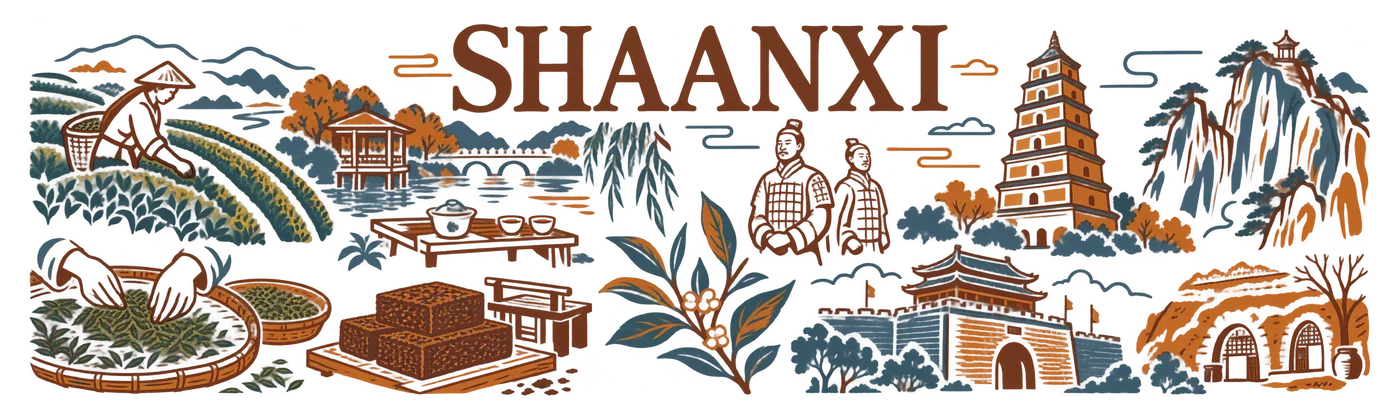
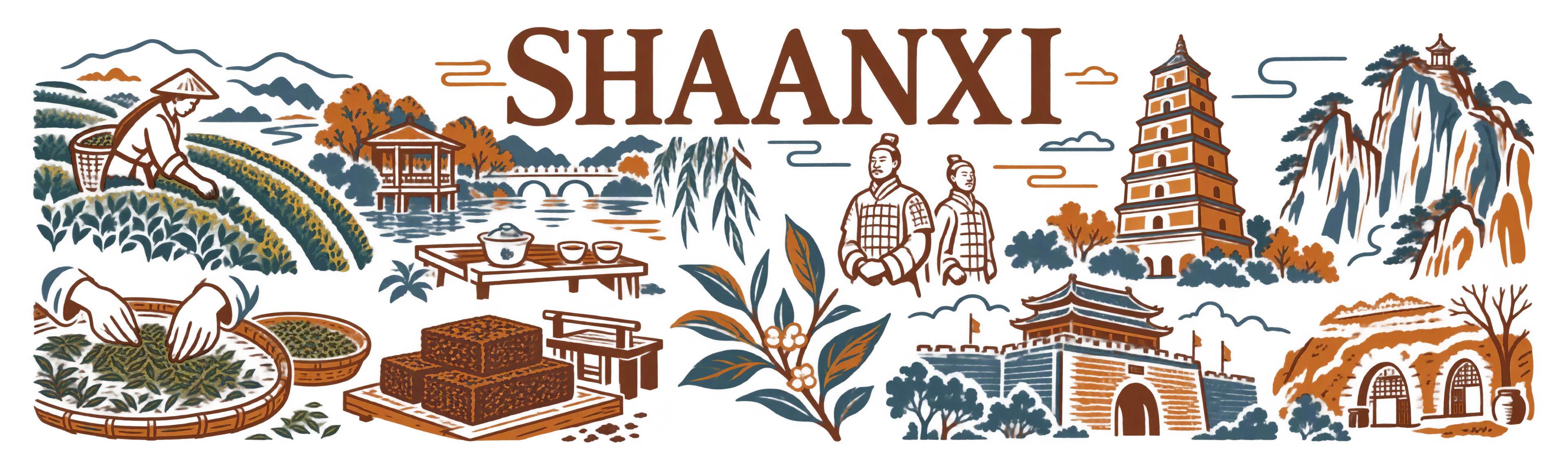
C7: drawing method and real style references
Factual basis and choice of subjects
Ten open local episodes, from tea slopes to ancient walls.
Title and drawing language
The assignment provides only one word — SHAANXI, in large Latin serif letters. Small place names, Chinese text, numbers, and third-party logos are excluded. This is a description of the assignment; actual legibility is assessed separately.
Drawing method and style references
Photographs of real tourist mugs with city scenes of Guangzhou, Macau, Hong Kong and Zhuhai were studied. From them, observed drawing features were taken: medium lively hand outline, simple recognizable silhouettes, selective flat color accents and a large title in the upper band. The specific set of viewed angles varied by region.
Local scenes vary in scale, shape, and height. Their juxtaposition creates an overall rhythm; a continuous panorama, a shared horizon, a grid of identical modules, and a fixed percentage of empty space are not imposed. Transparency is preserved between and within outlines.
The ceramic surface, highlights, hands, and the object background of the photographs are not part of the new drawing. Reference images and personal source photos are not published here. The three colors of each region are the author's palette, not a measured paint standard of the photographed cup.
Review basis
Reviewed white, dark and PNG: confident outline, clear openings, legible SHAANXI. Tea picking, handwork and bricks combine with architecture; conventional sleeve cut-offs remain a local illustration device.
PNG RGBA 3840 × 1152 px; real alpha channel; proportional export 250 × 75 mm.
Approved after review for the open gallery; does not imply the user's endorsement of industrial production.
Creative brief palette
#744432
#C17532
#536F82
Original generation prompt
Text matches the public TXT. The list of inscriptions and details describes the author's brief; this is not OCR and not a promise of reproducibility without the references used.
SHA-256: 6483e66c6a856ea74d4d5a02fc78dfd7d1697f9b4b5e5bee86fc0c034caca057
Read the full prompt
Create an exceptional original flat illustration for a collectible tea-region ceramic wrap. The attached image is a STYLE reference, not a content reference: preserve its drawing intelligence, print character and relationship between title, scenes and empty glaze; replace every Guangdong-specific subject and word. Output one panoramic native 3840 x 1280 pixel PNG with a genuine RGBA alpha channel. All artwork, including lettering, must remain wholly inside x60..3780 and y110..1170. The upper and lower outside bands and the external negative space must be transparent, not white paint. The final production crop will be 3840 x 1152 pixels for a 250 x 75 mm wrap; do not draw dimensions, crop marks or a frame. No mug, mockup, photograph, simulated paper, decorative rectangular background, cast shadow, checkerboard or watermark.

COLLECTION C7 — REFERENCE CUP CONTOUR.
Follow the actual souvenir-cup drawing language closely: medium-weight lively hand contour, simple recognisable silhouettes, soft three-ink palette, sparse flat accents and a few short expressive strokes. No fine engraving, crosshatching carpet, watercolour, gradients, tonal rendering or solid panorama. Arrange 8 to 10 unequal local episodes in a lively interlocking rhythm; a few form close pairs and others breathe through generous irregular clear glaze. This is NOT an evenly spaced icon grid or two perfectly aligned rows. One large elegant serif title in the upper band. Its simple confident charm must be apparent at mug scale.

REGION: SHAANXI. EXACT PALETTE: #744432, #C17532, #536F82. Use only these opaque graphic inks and their clean antialiased edges; no white ink, black substitution or extra colours. Transparent negative space is not an additional ink.

Draw ten unequal medium-contour episodes: Hanzhong tea picker with two curved rows; Ziyang river tea table; Pingli leaf-sorting hands and basket; Jingyang Fu brick and open workbench; a broad tea branch; Xi'an city-wall gate; a tall pagoda; two terracotta warrior sculptures; sharp Huashan rock with a tiny pavilion; a northern yaodong doorway. Tea is half the content. Northern architecture has no growing tea plants. Use sparse three-ink flat accents, open walls and vessels, clean transparent glaze and no tiny decorative writing.

REGIONAL TRUTH: Shaanxi has real southern tea cultivation in Hanzhong and Ankang: Hanzhong Xianhao, Ziyang teas and Pingli Nuwa tea are established regional identities. Shangluo also has tea production under the Qinling Quanming regional name. Jingyang in the north is a Fu brick-tea processing and trade centre; do not invent a northern Jingyang plantation. Fu tea is compressed dark tea and must appear as textured bricks, separate from loose southern green tea. The Qinling range, Han River and the dry northern loess provide the province's meaningful geographic contrast. Show no medical promises, selenium diagrams or goddess claiming to make tea.

SPECIFIC COMPOSITION: The single upper serif SHAANXI is correctly spelled. A tall pagoda and branch balance the low brick bench and city gate. Pair only nearby episodes and vary their sizes dramatically; no aligned stamp row, dense engraved background or all-enclosing mountains.

TEXT: Only one word, "SHAANXI". No other letters, numbers, captions or language anywhere.

Keep the entire title and every object inside the safe field. Use only the specified three inks with clean alpha-zero glaze around and within open forms. No white backing, opaque sky, wash, shadows, writing, border or cut-off object. Finish as a confident simple collector-cup illustration, not a presentation sheet.