Inner Mongolia / NM_C7
Inner Mongolia — Through real cups
Ten large episodes in simple outline: six tea actions and four groups of regional motifs.
Checked for publication · Drawing review and technical check of the current file
C7: drawing method and real style references
Factual basis and choice of subjects
Ten large episodes in simple outline: six tea actions and four groups of regional motifs.
Title and drawing language
The assignment provides for only one word — INNER MONGOLIA, in large Latin serif letters. Small toponyms, Chinese text, numbers, and third-party logos are excluded. This is a description of the assignment; actual legibility is assessed separately.
Narrative inventory of the original concept
Below are the planned groups from the English author's prompt, quoted verbatim. This is a transparent explanation of the choice of subjects, not a promise that the generator reproduced every detail.
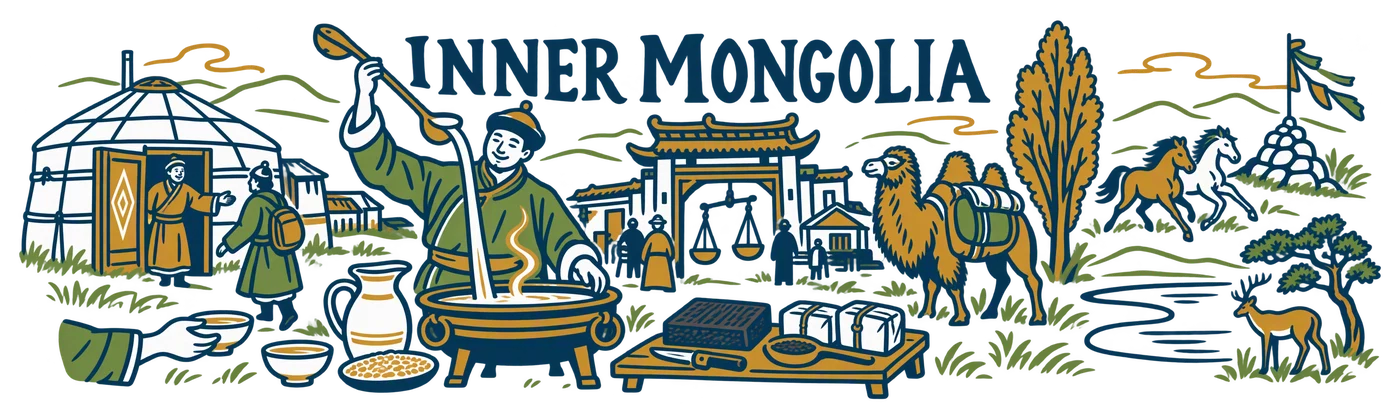
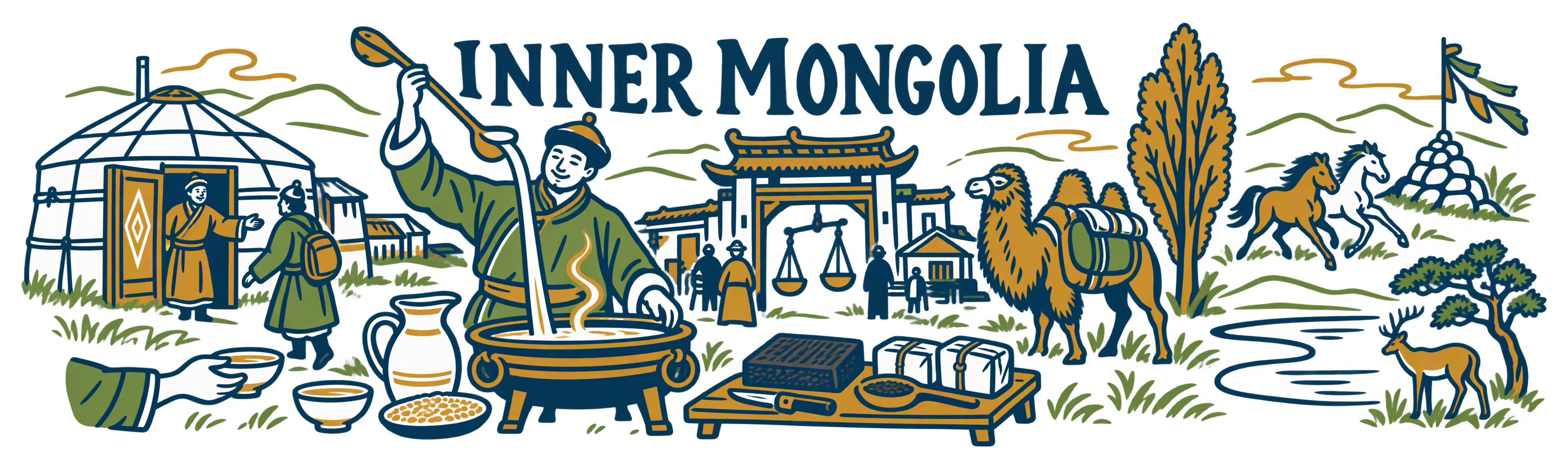
1. The dominant centre-left scene is a Mongolian host raising a long ladle above a generous metal cauldron. A single flowing arc of milk tea returns to the vessel. Draw the face, hands and ladle cleanly, without miniature jewellery or fabric patterns.
2. Near the cauldron, a clear milk jug and two bowls form one medium still life. One bowl is offered by an outstretched hand; add a small dish of toasted grain as simple oval marks, not noise.
3. A complete round yurt, with a single open door and a guest being welcomed, sits at the left. Keep the roof, base and people entirely visible. One simple geometric door stripe is enough.
4. A low tea-trade table with one compressed rectangular tea brick, a knife resting beside it, a scoop and two neatly wrapped imported tea parcels. Draw the brick with six short hatch strokes, not a fuzzy carpet.
5. One Hohhot-style merchant gate with a balance scale suspended in its open arch; the weight pans and rope knots are clear.
6. A loaded two-humped Bactrian camel beside a tall golden poplar. Both are confident complete silhouettes, with a few saddle lines.
7. Two energetic horses and a small stone ovoo with one pennant form a taller eastern counterpoint; use just five large stones, no dense rocky mass.
8. A shallow lake contour, one pine and one deer quietly close the right end. The lake is three clean open curves, never a filled patch of water.
Drawing method and style references
Photographs of real tourist mugs with city scenes of Guangzhou, Macau, Hong Kong and Zhuhai were studied. From them, observed drawing features were taken: medium lively hand outline, simple recognizable silhouettes, selective flat color accents and a large title in the upper band. The specific set of viewed angles varied by region.
Local scenes vary in scale, shape, and height. Their juxtaposition creates an overall rhythm; a continuous panorama, a shared horizon, a grid of identical modules, and a fixed percentage of empty space are not imposed. Transparency is preserved between and within outlines.
The ceramic surface, highlights, hands, and the object background of the photographs are not part of the new drawing. Reference images and personal source photos are not published here. The three colors of each region are the author's palette, not a measured paint standard of the photographed cup.
Review basis
Clean souvenir-cup contour, three controlled inks, clear Inner Mongolia title; milk-tea cauldron, brick trade, yurt, camel and grassland landmarks readable.
PNG RGBA 3840 × 1152 px; real alpha channel; proportional export 250 × 75 mm.
Approved after review for the open gallery; does not imply the user's endorsement of industrial production.
Creative brief palette
#204D6D
#BE923B
#7B984A
Original generation prompt
Text matches the public TXT. The list of inscriptions and details describes the author's brief; this is not OCR and not a promise of reproducibility without the references used.
SHA-256: 02324269d0d7809851ee10083a0ce710b54334b0bc4474cef3ce1eb296fa1c6d
Read the full prompt
Create a sophisticated hand-drawn tourist-souvenir illustration for INNER MONGOLIA, combining steppe travel and tea hospitality. Match the supplied successful flat souvenir drawing's confident medium outlines, irregular large object sizes, spare explanatory detail and selective flat colour. Borrow the drawing method only, never the reference's geography or lettering. This is an original flat wrap, not a photograph or product mockup.

Native transparent PNG RGBA, 3840 x 1280 pixels. All artwork fits fully inside x=100..3740 and y=130..1150, suitable for final 3840 x 1152 pixels and 250 x 75 mm. Genuine zero-alpha background and open interiors throughout. No paper or ceramic texture, white fill, rectangular backdrop, photographic shading, cast shadows, hazy pigment, gradient or translucent smudge. Every main contour is a clear uninterrupted 5–7 pixel pen line, gently irregular but sharply resolved. Interior details are sparse and equally clean. Use only navy #204D6D, ochre #BE923B and steppe green #7B984A. Navy draws outlines; ochre and green fill selected garment, saddle, door and vessel details. Leave most interior surfaces unfilled alpha. No grain or distressed printing.

Build EIGHT large unequal scenes that nest into one another with a lively rhythm, like a beautiful illustrated travel journal wrapped around a cup. The only lettering is INNER MONGOLIA, once, in large friendly upright hand-lettered capitals, with every letter complete. No small labels, numbers, Chinese script, logos or ornamental pseudo-text.

1. The dominant centre-left scene is a Mongolian host raising a long ladle above a generous metal cauldron. A single flowing arc of milk tea returns to the vessel. Draw the face, hands and ladle cleanly, without miniature jewellery or fabric patterns.
2. Near the cauldron, a clear milk jug and two bowls form one medium still life. One bowl is offered by an outstretched hand; add a small dish of toasted grain as simple oval marks, not noise.
3. A complete round yurt, with a single open door and a guest being welcomed, sits at the left. Keep the roof, base and people entirely visible. One simple geometric door stripe is enough.
4. A low tea-trade table with one compressed rectangular tea brick, a knife resting beside it, a scoop and two neatly wrapped imported tea parcels. Draw the brick with six short hatch strokes, not a fuzzy carpet.
5. One Hohhot-style merchant gate with a balance scale suspended in its open arch; the weight pans and rope knots are clear.
6. A loaded two-humped Bactrian camel beside a tall golden poplar. Both are confident complete silhouettes, with a few saddle lines.
7. Two energetic horses and a small stone ovoo with one pennant form a taller eastern counterpoint; use just five large stones, no dense rocky mass.
8. A shallow lake contour, one pine and one deer quietly close the right end. The lake is three clean open curves, never a filled patch of water.

Vary their size and height. Let the ladle arc, gate opening, yurt roof and horse movement answer each other; avoid a rigid grid or a full landscape horizon. Tea preparation and hospitality occupy roughly half the illustrated subject matter. This region consumes imported tea: no local Camellia plantation and no invented healing claim. Aim for crisp, charming, expressive marks that remain beautiful on a real small ceramic object. No blurred ends, tiny landscapes or smoky bridges between the scenes.