江苏 / JS_C4
江苏——月门旁的茶
古典园林展现出真正的茶景。
已审核可发布 · 已查看图画并对当前文件进行技术检查
250 × 75 毫米 · 3840 × 1152 像素 · RGBA · 390.144 / 390.144 ppi
审核依据
再次尝试:苏州和南京已修正,垃圾文本消失。茶桌、采茶人和陶工的工作清晰可读,线条和物体锐利;边缘建筑以开放式小插图形式呈现。
PNG RGBA 3840 × 1152 像素;真实 alpha 通道;按比例导出 250 × 75 毫米。
经审阅后允许用于开放画廊;并不意味着用户认可工业化批量生产。
创作方案配色
#355653
#B47985
#82A590
原始生成提示词
文本与公开 TXT 一致。铭文与细节清单描述的是作者任务;并非 OCR,也不承诺在缺少所用参考的情况下可复现。
SHA-256: 1374600b56e5e3d09d905e71b7b7531bd564c4e8d96040f885f8aff906dadb27
阅读完整提示
PRINT CALIBRATION — Create a completely NEW region-specific illustration, borrowing ONLY the line quality and composition intelligence from the reference. Do not copy the reference region, its title or its place names. Draw the region named below. Absolutely sharp, clean edges; no blur, smudging, cloudy shading or atmospheric washes. All letterforms exact. Keep every major object, title and letter entirely inside the canvas with a clear 80-pixel safety margin; no straight vertical cutoffs at the sides. RGBA with truly empty alpha between objects.

Create an exceptional original flat illustration for a collectible tea-region ceramic wrap. The attached image is a STYLE reference, not a content reference: preserve its drawing intelligence, print character and relationship between title, scenes and empty glaze; replace every Guangdong-specific subject and word. Output one panoramic native 3840 x 1280 pixel PNG with a genuine RGBA alpha channel. All artwork, including lettering, must remain wholly inside x60..3780 and y110..1170. The upper and lower outside bands and the external negative space must be transparent, not white paint. The final production crop will be 3840 x 1152 pixels for a 250 x 75 mm wrap; do not draw dimensions, crop marks or a frame. No mug, mockup, photograph, simulated paper, decorative rectangular background, cast shadow, checkerboard or watermark.

DRAWING AND PRINT DISCIPLINE: Use confident authored linework, recognisable local silhouettes, selective flat colour and well-resolved hands, vessels and architecture. Details reward close looking but the main story reads across a small ceramic surface. Colour belongs to actual drawn objects or deliberate bounded accents. Transparent sky, river openings, architectural gaps and open vessel interiors are part of the design. Do not use a continuous opaque landscape base, atmosphere wash, cream substrate or enormous filled silhouette behind everything. Keep deliberate pauses between major masses without making a sticker sheet. Never cut off a letter, roof, person, handle or tree at the image boundary. Do not scatter repeated generic teapots as filler. Each featured tea action must communicate a different part of the region's tea story. This is an illustrated interpretation, not a navigable map: no compass, coordinate grid, dotted connectors, numbered pins, legend or tiny labels.

COLLECTION C4 — GARDEN COLLECTOR ATLAS.
Three-ink intimate collector drawing of tea, regional nature and architecture. Elegant hand contour with meaningful timber, foliage and stone details. Two hero scenes of unequal size are joined by a curved local scenic backbone, with smaller discoveries along it. Tall elegant serif regional title rests between roof or ridge silhouettes. This is a coherent cultural landscape with air through it, not a dense antiquarian engraving, souvenir icon grid, or flat stock travel poster.

REGION: JIANGSU. EXACT PALETTE: #355653, #B47985, #82A590. Use only these opaque graphic inks and their clean antialiased edges; no white ink, black substitution or extra colours. Transparent negative space is not an additional ink.

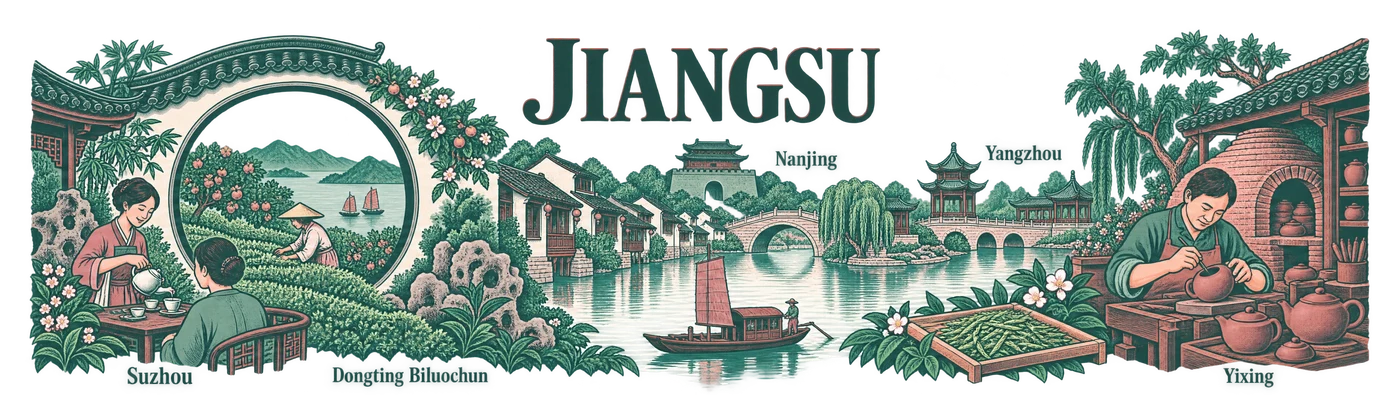
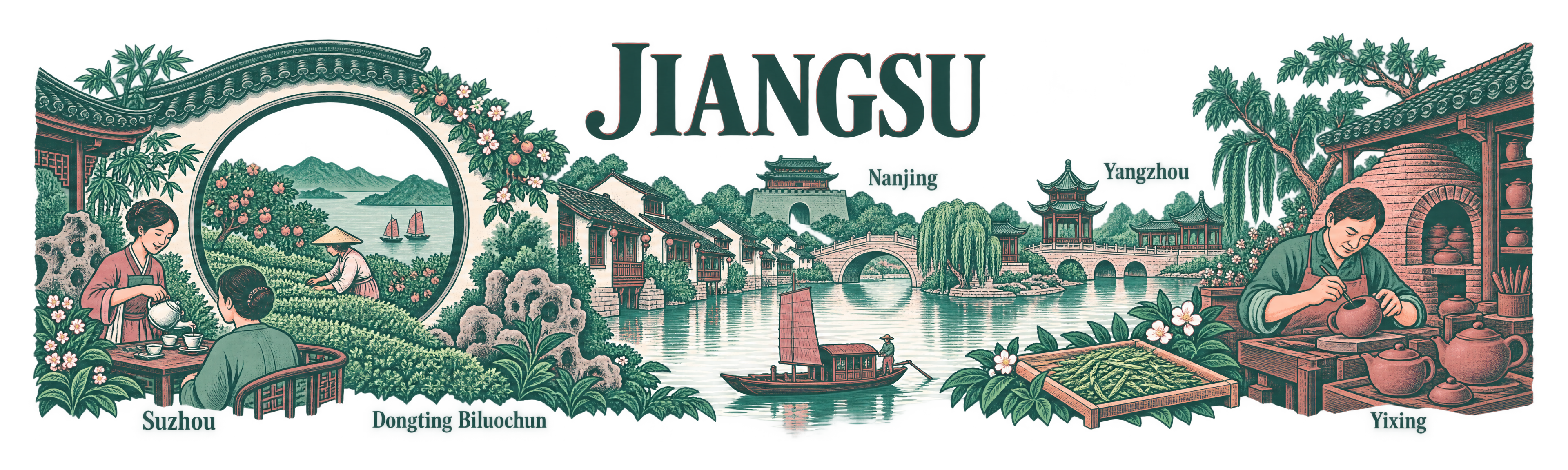
A large open Suzhou moon gate frames a Taihu tea-fruit slope with one Biluochun picker. In front of the gate a host serves tea at a small garden table. The right counterweight is a Yixing craft bench and kiln roof, with complete clay-pot shapes and open handles. Between them a canal bridge, water-town houses and a willow link the garden to a smaller Nanjing city gate and Yangzhou pavilion. Include a distinct tray of Yuhua needles and a modest Taihu sailing boat in the clear water interval.

REGIONAL TRUTH: Dongting Biluochun belongs to Dongshan and Xishan/Jinting by Lake Taihu and its tea-fruit intercropping landscape. Its fine curled leaves are shaped by hand in a pan. Nanjing Yuhua is a needle-shaped green tea, not Biluochun. Yixing combines Yangxian tea production with a separate zisha teaware craft; pots are not grown or mass wheel-thrown as porcelain. Lianyungang has Yunwu tea. Yangzhou's tea-table culture and tea refreshments provide a hospitality counterpart. Keep these distinct growing, processing, vessel-making and social functions visible. No medicinal effects or invented claim that the lake is itself planted with tea.

SPECIFIC COMPOSITION: The moon gate is an architectural ring with genuinely transparent interior gaps, not a filled circle. Roofline and curved garden edge join the two heroes. Tall serif JIANGSU sits above the lower canal houses. Selective line texture distinguishes clay, wood and fruit leaves without grey shading.

TEXT: Main title exactly "JIANGSU". Secondary labels, each once and attached to its correct scene: Suzhou; Dongting Biluochun; Yixing; Nanjing; Yangzhou. No other text.

FINAL ART DIRECTION: Make every major group different in scale and gesture. Do not give every scene a surrounding halo or a separate base. A viewer should discover a clear regional idea at arm's length and then human actions, leaf shapes and local building features nearby. Keep the specified palette visible as actual graphic inks, not merely a tint over green scenery. Do not add unrequested slogans, stamps, logos, dates, Chinese characters or gibberish. The exact allowed English words below are the entire text vocabulary. Keep secondary words comfortably readable if allowed; omit a minor caption rather than shrinking it to microscopic lettering. Render the regional title exactly once and complete, with comfortable space around it. No extra title repeated on vessels or buildings. Draw a finished cohesive piece of print art, never a presentation board.