福建 / FJ_C4
福建——庭院、岩崖与茶作坊
永定圆形土楼和武夷山岩是两种主要尺度;在它们之间展开的是福建的居住茶文化。
已审核可发布 · 已查看图画并对当前文件进行技术检查
250 × 75 毫米 · 3840 × 1152 像素 · RGBA · 390.144 / 390.144 ppi
审核依据
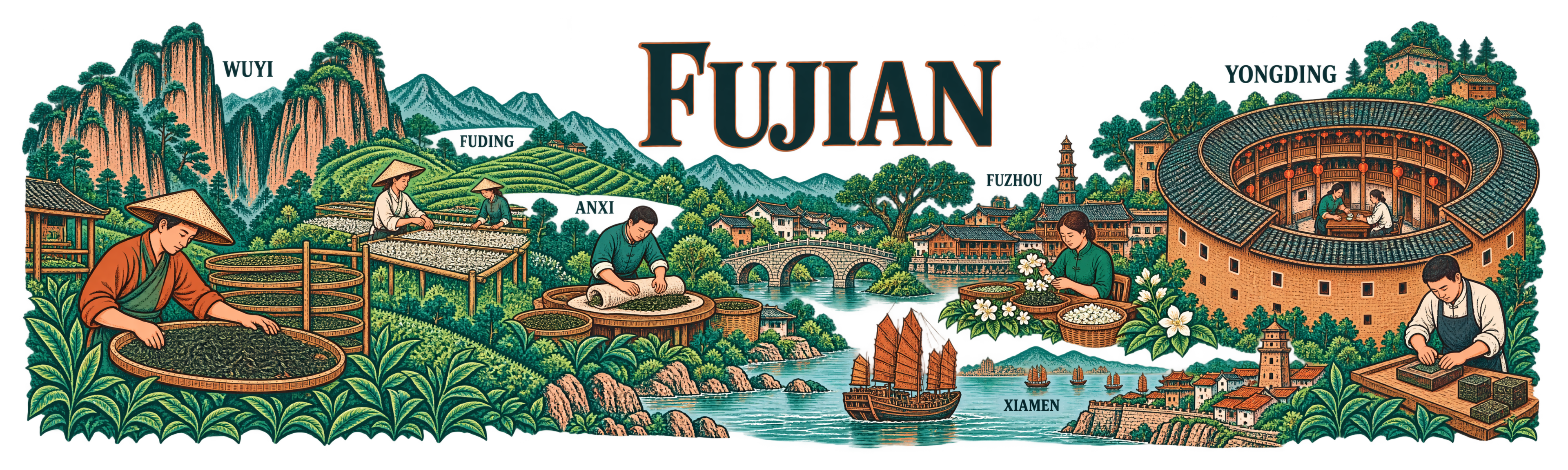
地图集第三版:干净细致的线条,完整的“福建”,武夷与圆形永定作为不同主体;制茶流程与城市桥梁相连。RGBA 与开放留白得以保留。
PNG RGBA 3840 × 1152 像素;真实 alpha 通道;按比例导出 250 × 75 毫米。
经审阅后允许用于开放画廊;并不意味着用户认可工业化批量生产。
创作方案配色
#245D58
#AB653D
#829C49
原始生成提示词
文本与公开 TXT 一致。铭文与细节清单描述的是作者任务;并非 OCR,也不承诺在缺少所用参考的情况下可复现。
SHA-256: f7b8656ebc396e016261172addd35039a418cd500c4c2ecf26e782ab59897dd3
阅读完整提示
DRAWING CALIBRATION: The supplied clean example shows the required crisp professional print finish; borrow its line clarity and art direction only, replace its entire regional subject matter with the region specified below. All forms use deliberate sharp edges and clear internal strokes. No fog, painterly smearing, wobbly double text or background colour fields. Transparent alpha is mandatory, including outside and between objects. Do not paint the example white viewing surface. Keep all letters and complete objects 120 px inside every native edge.

REVISED PRODUCTION PRIORITY: Render exceptionally clean sharp linework and crisp lettering, never a blurred imitation of the reference. Every outside edge and all empty openings must be truly transparent alpha zero. Absolutely no opaque white canvas. All complete objects must end at least 100 pixels before left/right borders and 120 pixels before top/bottom borders; do not crop the drawing. Use defined ink strokes with transparent gaps instead of fog, grey halos or soft shadows. Preserve the regional composition below. The supplied reference has a white viewing surface; this viewing surface is not part of the new output.

Create an original collectible regional ceramic PRINTING DECAL, not a mug or mockup. The supplied image is a drawing/style benchmark only: replace every reference-region subject and word with the researched region described below. Make a confident, rewarding composition whose tea craft, architecture and landscape belong together.
OUTPUT: PNG RGBA, native 3840 x 1280 px. Keep every mark inside x=60..3780 and y=110..1170; use nearly the whole long strip. The final export is 3840 x 1152 px for 250 x 75 mm. Do not shrink the entire design to a central 16:9 picture. Preserve normal object proportions and complete edge objects.
ALPHA: genuine transparent exterior and natural transparent openings inside the drawing. No white or cream rectangle, paper texture, sky wash, sea fill, provincial silhouette, checkerboard, aura, gradient or drop shadow. Unpainted architecture, water and negative openings reveal alpha. Colour belongs to actual drawn objects, never a vague backdrop. Do not reproduce any opaque field visible in the reference.
For C1–C6, create ONE connected varied panorama with two or three unequal anchors, overlapping near/middle/far scales and smaller discoveries. Connect through real terrain, streets, roofs, branches and human actions, not dotted diagram routes. No two-row sticker sheet, isolated equal scenes, caption boxes, repetitive generic gardens or an empty band under the title. Do not impose a percentage of blank space. C7 instead follows its explicit irregular album direction below.
English lettering only, exact spelling, dark clear capitals for allowed captions. One main regional title. No Chinese characters, logos, invented seals, pseudo-writing, promotional superlatives or health claims. A short legible caption is preferable to microscopic text. Respect the stated distinctions between growing tea, processing it, trading it and serving it. A full research inventory need not become a printed gazetteer.

COLLECTION: AN INTIMATE HAND-DRAWN ATLAS. Follow GD01: richly observed buildings, objects, plants and lived tea culture, in three inks. Draw disciplined collector engraving with beautiful changes of scale. A curved scenic backbone links two unequal hero stories; smaller details share the terrain. An elegant serif title belongs among roofs or ridges. No independent encyclopaedia panels.
REGION: FUJIAN.
PALETTE: #245D58, #AB653D, #829C49. Preserve this regional colour family; first colour supplies the strongest contour/text. Extra dark/light rendering colours and full-colour watercolour are not wanted.
RESEARCHED CONTENT:
The source map offers Wuyi cliff towers and lower tea gardens, northern white-tea slopes, Daiyunshan ridges, the Min River, Fuzhou waterside roofs, Sanming and Putian settlement details, a round Yongding tulou, Anxi terraces, Quanzhou coastal roofs, the Jiulong River, Xiamen and Zhangzhou harbours, stone arched bridges, sailing junks and coastal islets. Use these as regional visual facts, not a literal flattened map or named identification of anonymous buildings. Keep six substantial tea stories: Wuyi rock-oolong tray work; Fuding/Zhenghe open white-tea withering racks; Anxi cloth rolling and little rolled leaves; Fuzhou jasmine scenting table; Zhangping square cake mould; a small southern garden associated with Yongchun/Pinghe. Tulou is lived architecture, not a giant teapot. Tea chests and a junk support coastal trade, while the separate mountain gardens show cultivation. Ordinary roofs and footbridges link human scale to the much larger cliffs and courtyard. Show no tea fields on bare cliff summits or in the sea.
AUTHORED COMPOSITION:
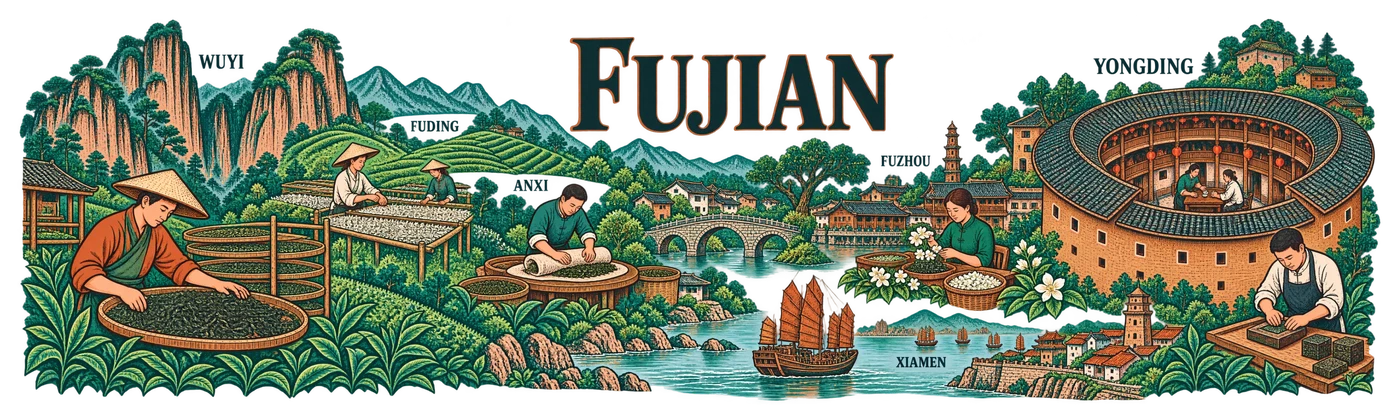
Put a magnificent round Yongding tulou in the near right half, opened just enough to see its real inner courtyard, balcony rhythm and a modest tea-sharing table. On the far left, tall Wuyi cliff towers rise behind a close maker shaking a leaf tray. A curved mountain-and-roof backbone travels between these unequal anchors through a small stone bridge, northern white-tea drying racks, an Anxi rolling cloth and a jasmine table near Fuzhou waterside roofs. Do not place the tulou in the northern cliff valley: the curved drawing is a regional itinerary, not one physical village. A tiny Zhangping square mould at the courtyard-edge workbench supplies a memorable specialist detail. Below, Jiulong water strokes and a sailing junk continue toward the Xiamen/Zhangzhou coastal roofs; Putian and Quanzhou appear as modest coastline settlement rhythms. FUJIAN sits elegantly in a valley opening above the bridging roof sequence. Use richly observed but selective three-ink engraving on timber, basket and foliage, with untouched transparent court and water openings.
LETTERING PLAN:
FUJIAN once. At most six neat captions: WUYI, FUDING, ANXI, YONGDING, FUZHOU, XIAMEN. Unnamed map bridges stay unnamed; do not invent temple names.
REGIONAL SAFEGUARDS:
Tea forms must differ: long rock-tea strips, white buds/leaves, rolled Anxi oolong and square Zhangping cakes. Jasmine is added during scenting of actual tea, not a medicinal herbal drink. Foshou is a tea name, not sliced Buddha's-hand citrus; Shuixian is not a narcissus-flower infusion. Keep Min and Jiulong as editorial river rhythms rather than one false hydrological channel. No mainland-wide landmark collage, no pagodas duplicated at every cluster, no exact-date or healing claims.
FINAL STANDARD: sharply drawn object edges, deliberate line hierarchy, vivid meaningful local differences and a recognisable whole place. Protect the main title and key silhouettes; never solve complexity by making everything equally tiny.