Шаньси / SX_C7
Шаньси — По реальным кружкам
Девять крупных эпизодов простым контуром; местный настой форзиции отделён от привозного чая.
Проверено для публикации · Просмотр рисунка и техническая проверка текущего файла
C7: метод рисунка и реальные стилевые референсы
Региональное исследование и источники
Фактическая основа и выбор сюжетов
Девять крупных эпизодов простым контуром; местный настой форзиции отделён от привозного чая.
Название и язык рисунка
В задании предусмотрено только одно слово — SHANXI, крупными латинскими буквами с засечками. Мелкие топонимы, китайский текст, числа и сторонние логотипы исключены. Это описание задания; фактическая читаемость оценивается отдельно.
Метод рисунка и стилевые референсы
Изучены фотографии реальных туристических кружек с городскими сюжетами Guangzhou, Macau, Hong Kong и Zhuhai. Из них взяты наблюдаемые признаки рисунка: средний живой ручной контур, простые узнаваемые силуэты, выборочные плоские цветовые акценты и большое название в верхнем поясе. Конкретный набор просмотренных ракурсов различался по региону.
Местные сцены имеют неодинаковый масштаб, форму и высоту. Их соседство создаёт общий ритм; непрерывная панорама, общий горизонт, сетка одинаковых модулей и фиксированный процент пустоты не задаются. Между и внутри контуров сохраняется прозрачность.
Керамическая поверхность, блики, руки и предметный фон фотографий не входят в новый рисунок. Изображения референсов и личные исходные фотографии здесь не публикуются. Три цвета каждого региона являются авторской палитрой, а не измеренным стандартом краски сфотографированной кружки.
Основание проверки
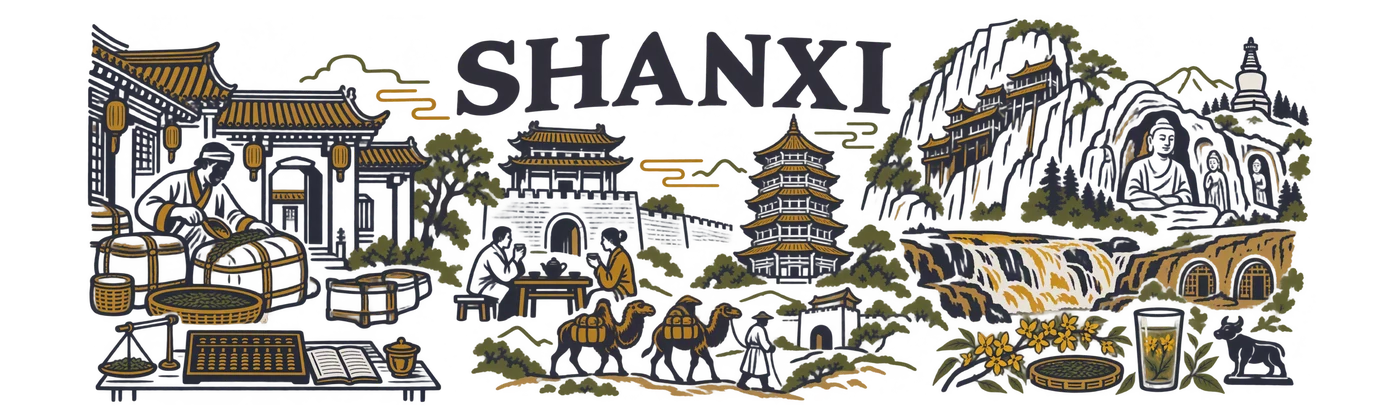
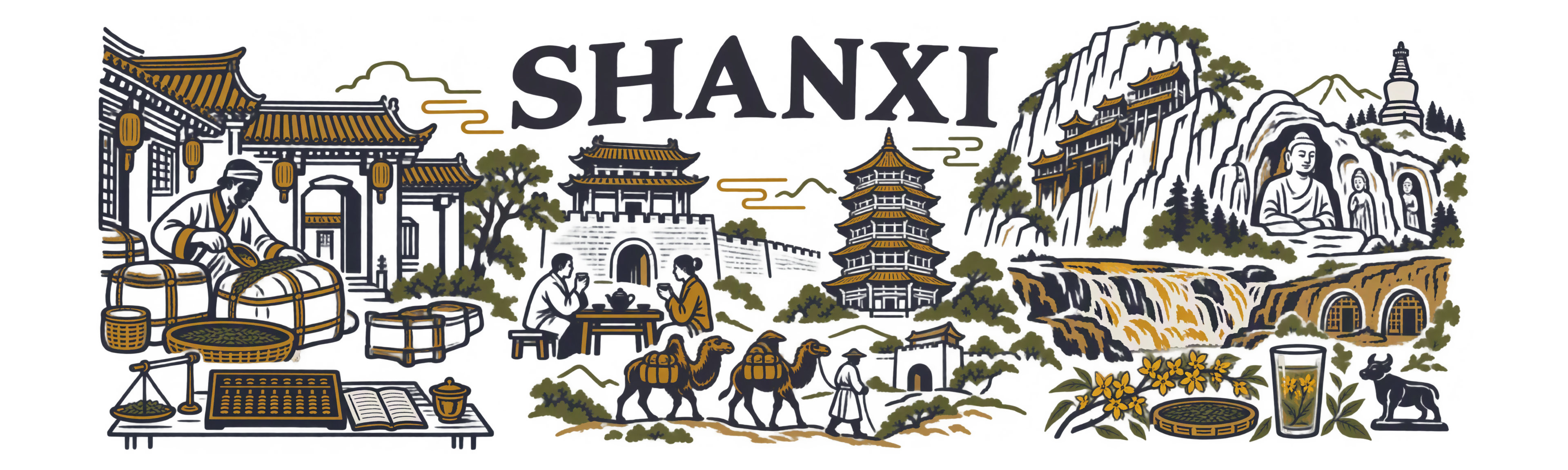
SHANXI единственный крупный заголовок, чистый средний контур и открытые внутренности. Тюки, весы, счёты, чаепитие и архитектурные мотивы легко различимы; нет прежней живописной мягкости. Это туристическое собрание эпизодов, не покомпонентно точная карта.
PNG RGBA 3840 × 1152 px; настоящий альфа-канал; пропорциональный экспорт 250 × 75 мм.
Допущен после просмотра для открытой галереи; не означает утверждение пользователем промышленного тиража.
Палитра авторского задания
#3A3C49
#B28A39
#797356
Точное текстовое задание
Текст совпадает с публичным TXT. Перечень надписей и деталей описывает авторское задание; это не OCR и не обещание воспроизводимости без использованных референсов.
SHA-256: c66afd1931708c318884c1c51fce568a34044a992086d04d83bf5774f4866490
Прочитать полный промпт
RENDERING REQUIREMENTS: Produce a new, completely crisp region-specific illustration. Borrow ONLY drawing style from the references; do not copy their region, title or place names. Use the exact region and English lettering in the brief. No blurred patches, mist, smoky shading, translucent brush smears or soft-focus architectural details. No clipping of objects or letters: keep an 80-pixel clear safety margin around the complete composition. True PNG RGBA transparency between the drawn shapes; no opaque white or coloured backing. Sharp ink edges, legible deliberate lettering.

Create an original flat souvenir-cup decal, not a mug mockup or a photographed product. Follow the approved real-cup outline style with simple shapes and restrained accents. Do not reproduce the source map's parchment, dense relief shading or filled scenery. Native canvas 3840 x 1280 pixels, actual RGBA PNG, with every mark safely inside x60..3780/y110..1170; final centered export is 3840 x 1152 for 250 x 75 mm. Keep all canvas margins alpha zero. No visible frame or printed technical information.

Use confident, slightly human 5–7 px outlines, readable at 75 mm print height. Most object bodies are open alpha-zero interiors: the ceramic itself becomes the unprinted colour. Only small, sharply bounded flat accent patches; no white or cream backing, no sky/ground slab, no brown wash, watercolor, airbrush, photographic texture, dense engraving or crosshatching. Use 3–5 short interior marks for an ordinary vessel or object, a few essential openings for a building. Tea steam is at most one or two open curls. No global ground line connecting every scene.

Arrange 8–10 substantial, unequal episodes in a lively irregular field. Put the largest episode off-center, let a tall narrow object answer it, and fit a few smaller ones into purposeful gaps. Different heights and natural overlaps are welcome, but every episode needs a legible silhouette and a clean breathing channel. No fixed whitespace percentage, no equal two-row sticker grid, no miniatures scattered under an enormous empty heading. Preserve real regional identity through observed objects and explicit tea actions. Never invent tea farms or label herbs as tea leaves. Architecture is a geographic motif; contemporary tea pauses are authored scenes, not historical evidence.


C7: REAL SOUVENIR-CUP PEN DRAWING. Match the approved Xinjiang and Shanghai cup illustrations through warm, assured medium outlines and selective small flat accents. At native size use approximately 5–7 px main strokes and only 3–5 interior strokes per simple object. Larger buildings may have a few more essential windows, never dense hatching. Most enclosed bodies remain transparent. Draw 8–10 unequal, generous subject groups at different heights, with irregular open channels between them. This is neither an evenly spaced icon grid nor a tightly packed panoramic painting. No watercolor, sepia haze, opaque cream objects, stippled shading or engraving.

REGION: Shanxi. Palette: #3A3C49, #B28A39, #797356. First colour is the main outline; remaining two are small flat accents. No additional inks.

Draw NINE large uneven episodes: (1) a Qixian-style merchant courtyard with one trader opening a tea bale and a visible leaf scoop, the main historical-trade group; (2) a tea balance, plain abacus and blank ledger on a compact counting desk, no invented script; (3) a Pingyao gate with a contemporary guest tea table and two cups; (4) two Bactrian camels and handler approaching a modest northern pass gate; (5) one Yingxian wooden pagoda with simplified stacked roofs and just essential openings; (6) a small Hanging Temple attached believably to a single sheer cliff; (7) Hukou waterfall as a few strong open strokes beside two loess cave-house arches; (8) a respectful small Yungang cave facade and distant Wutai stupa as one unequal architecture group; (9) a forsythia branch, leaf tray and separate herbal-infusion glass with a tiny iron-ox silhouette nearby. No tea plantation, no invented pressing factory, no historical banknote. The broad merchant scene and narrow pagoda balance each other; keep the supporting groups big enough to read at mug size. Main charcoal contours, restrained ochre roof/tea accents and muted olive leaves. Water, ceramic bodies and cliff interiors remain mostly unprinted. The title must say SHANXI, never SHAANXI.

PRINTED TEXT: exactly "SHANXI" once, near the upper composition, in warm hand-drawn block-serif capitals. This is the only visible text: no place names, subheadings, numbers, Chinese, labels, logos or signatures. Keep the word readable and scaled to the drawing, not an oversized empty banner. Preserve the anatomy and silhouette of local animals and vessels; do not repeat or multiply episodes to fill gaps. Deliver the drawing itself on genuine transparency.