Нинся / NX_C3
Нинся — Чайные территории
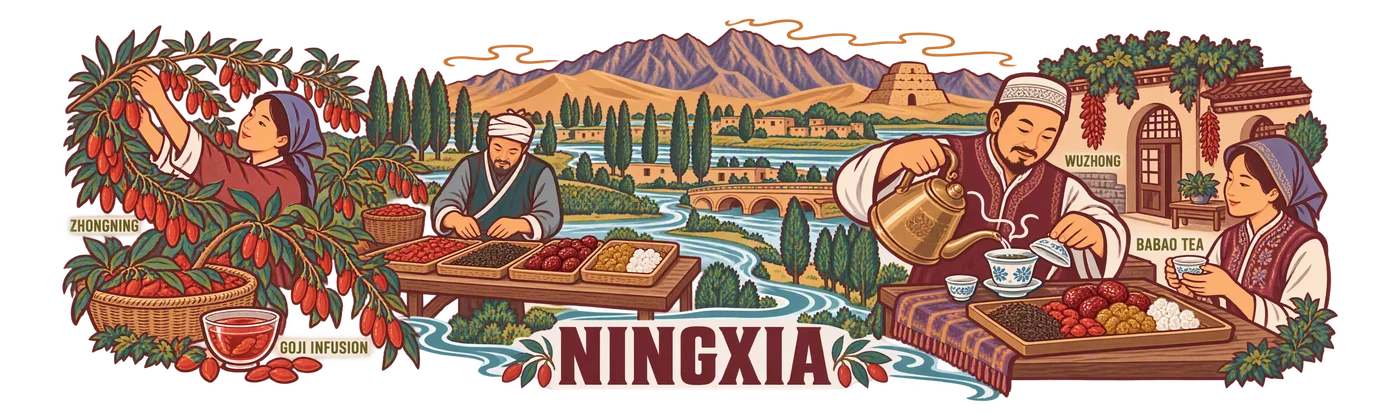
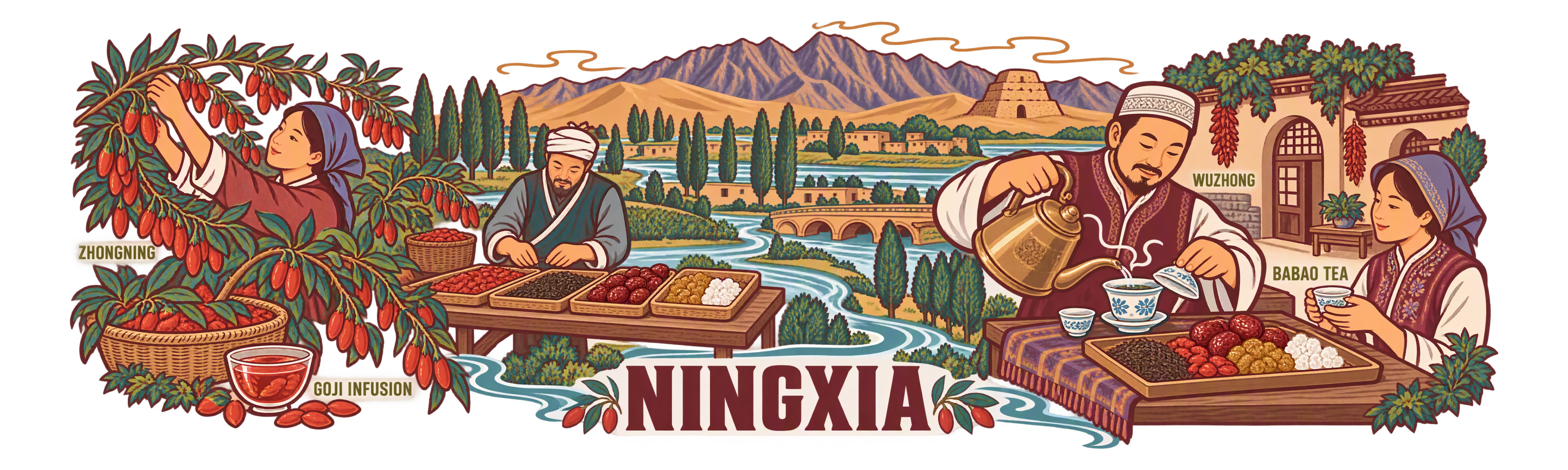
Канал соединяет сбор ягод, составление смеси и чайный двор.
Проверено для публикации · Просмотр рисунка и техническая проверка текущего файла
Региональное исследование и источники
Основание проверки
Целое NINGXIA и ясные подписи ZHONGNING/WUZHONG/BABAO TEA/GOJI INFUSION. Выразительные крупные жесты сбора, подготовки и заваривания с чёткими линиями; выращивание годжи отделено от чайной смеси. Общего непрозрачного прямоугольника на тёмном превью нет; интерьеры предметов имеют локальные заливки.
PNG RGBA 3840 × 1152 px; настоящий альфа-канал; пропорциональный экспорт 250 × 75 мм.
Допущен после просмотра для открытой галереи; не означает утверждение пользователем промышленного тиража.
Палитра авторского задания
#8B343F
#A28E42
#447C7C
#C28A62
#8E83A3
Точное текстовое задание
Текст совпадает с публичным TXT. Перечень надписей и деталей описывает авторское задание; это не OCR и не обещание воспроизводимости без использованных референсов.
SHA-256: c27891bc9de1183e99824629b8236ecefd34220f9edfa80da4c8511fb6132094
Прочитать полный промпт
Create one exceptional, completely flat regional ceramic-print artwork. This is the actual printable illustration, never a cup, product photograph, mockup, presentation board or simulated ceramic surface. The collection reference controls drawing language only: invent a new composition for the specified region and replace all Guangdong-specific objects. The source map supplies a regional inventory, not a paper texture or a layout to trace literally.

TECHNICAL CONTRACT: native canvas exactly 3840 x 1280 pixels, true RGBA PNG. Keep every visible mark, letter, ornament and antialiased edge inside x=60..3780 and y=110..1170. The final delivery will use a centered 3840 x 1152 export for a 250 x 75 mm wrap; leave the native safety area completely transparent. Compose for a long horizontal physical print, not a conventional poster. Nothing is cut off at either end. All exterior space and meaningful holes between objects must have alpha zero. No painted background, white underpainting, sky rectangle, tinted paper, land silhouette, colour fog, opaque backdrop or checkerboard. The wearer-visible ceramic supplies the unprinted space. Use the specified colours as ink, with normal edge antialiasing; do not invent extra white, black or metallic ink. Never print dimensions, crop marks, palette swatches, filenames, reference names or instructions.

ART DIRECTION: create a memorable hierarchy, a major focal scene and a quieter counterweight; alternate large close forms with medium stories and a few small discoveries. Let tea life interact with the region. Connect selected objects through a real roofline, tabletop, lane, ridge or river contour; retain clear breathing channels so each gesture and vessel is legible. Do not impose any percentage of empty space. Avoid both a cramped rectangular carpet and timid isolated stickers. Use confident, intentional linework that will survive the 75 mm print height. Limit texture to useful material clues. Any water, snow, steam or clouds are sparse outlines with transparent interiors, never washed fills. No photographic gradients, glow, heavy grunge, blurred edges or tiny illegible hatch fields.

FACTUAL DISCIPLINE: the scenes below distinguish cultivation, processing, trade, hospitality and non-tea infusions. Do not turn imported tea, berries, ginseng, barley, trees or grasslands into tea plantations. Do not invent a local tea cultivar, a named historic tea shop, medical effects, a precise trade route or archaeological evidence. Landmarks are cultural/geographic motifs, not assertions that tea was grown or traded at their gates. A contemporary tea pause next to a landmark is an authored scene, not a documentary historical claim. Keep people natural and respectful, with plausible hands and gestures; use no decorative pseudo-script.


C3: LIVING TEA TERRITORIES. Make an oblique, connected illustrated tea world, held together by a locally meaningful river, street, mountain fold or caravan corridor. Large foreground hospitality or craft overlaps medium buildings and small distant geography. Five flat inks, expressive editorial drawing and carefully observed vessels. No administrative outline, amusement-park badge grid or generic ornamental tea leaves. Integrate a strong condensed regional heading in the lower rhythm, not in a separate title band.

REGION: Ningxia. Exact ink palette: #8B343F, #A28E42, #447C7C, #C28A62, #8E83A3. The first colour supplies the main line; the others have deliberate separate roles, not gradients.

AUTHENTIC SUBJECT MATTER:
The hero is Wuzhong-style Babao hospitality: a host holds the saucer of a three-piece gaiwan while lifting the lid, a second hand pours hot water from a kettle, and a guest receives a separate cup naturally. On a broad ingredient tray show tea leaves, goji berries, dates, raisins and rock-sugar fragments as one plausible variant, not a claim that every recipe must have these exact quantities or eight fixed ingredients. A nearby preparer sorts the dry mix into small plain portions; the tea leaves have arrived through trade, not grown on the desert slopes. Zhongning is represented by a real goji shrub with narrow leaves and hanging elongated berries, a picker and a wicker fruit basket. Keep this agricultural plant clearly unlike tea. A small separate berry-only infusion may be shown beside the goji basket; it is not Camellia tea. A modest courtyard and a Yellow River irrigation contour connect ingredient to hospitality. The dry Helan ridge and one small stepped earthen tomb are distant geographic counterpoints, not invented historical tea sites. No medicinal copy, slogans or rigid etiquette claims.

SPECIFIC COMPOSITION:
Follow a sinuous irrigation channel from a goji orchard at the left to a courtyard Babao table at the right. The central bridge between them is an ingredient-sorting bench, visually demonstrating harvest, preparation and hospitality without claiming local tea-leaf cultivation. Let a large pouring kettle and tilted gaiwan lid form a memorable pair across the foreground. The dry Helan ridge, one dune and a small earthen tomb are upper counterweights. Integrate the regional title in the low channel opening. Show only a few irrigation branches so the composition is rich in actions, not a farmland grid.

VISIBLE TYPE: exact main title "NINGXIA" once. Use only these optional small English labels, integrated beside the appropriate scenes and large enough to read: WUZHONG, BABAO TEA, ZHONGNING, GOJI INFUSION. Do not add other text. No Chinese characters, bilingual captions, pseudo-calligraphy, gibberish, slogans, logos or signatures. Prioritize visual storytelling over words. Do not allow letters to merge with foliage or buildings. The design must feel like a collectible regional artwork that a tea professional would want to handle and study.