Внутренняя Монголия / NM_C3
Внутренняя Монголия — Чайные территории
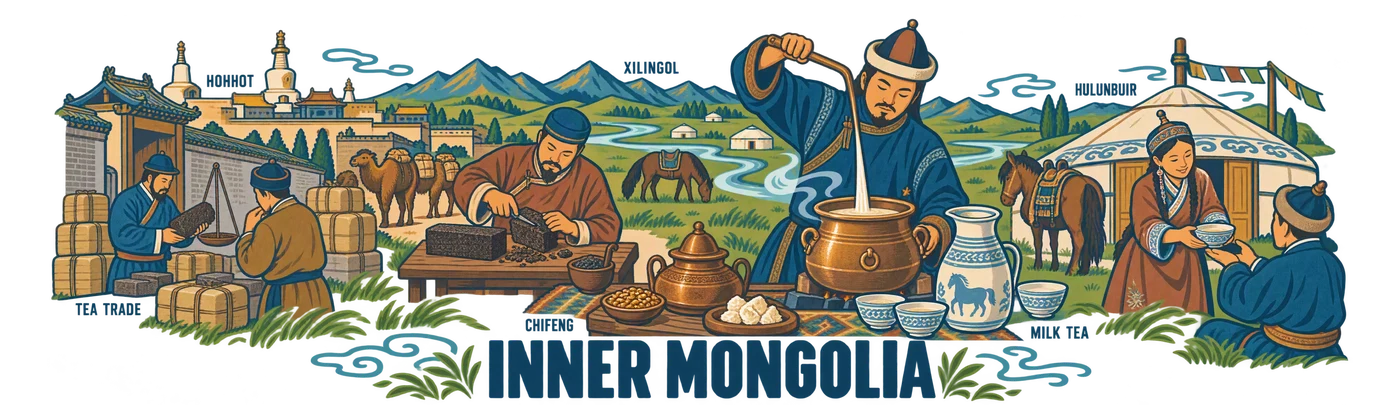
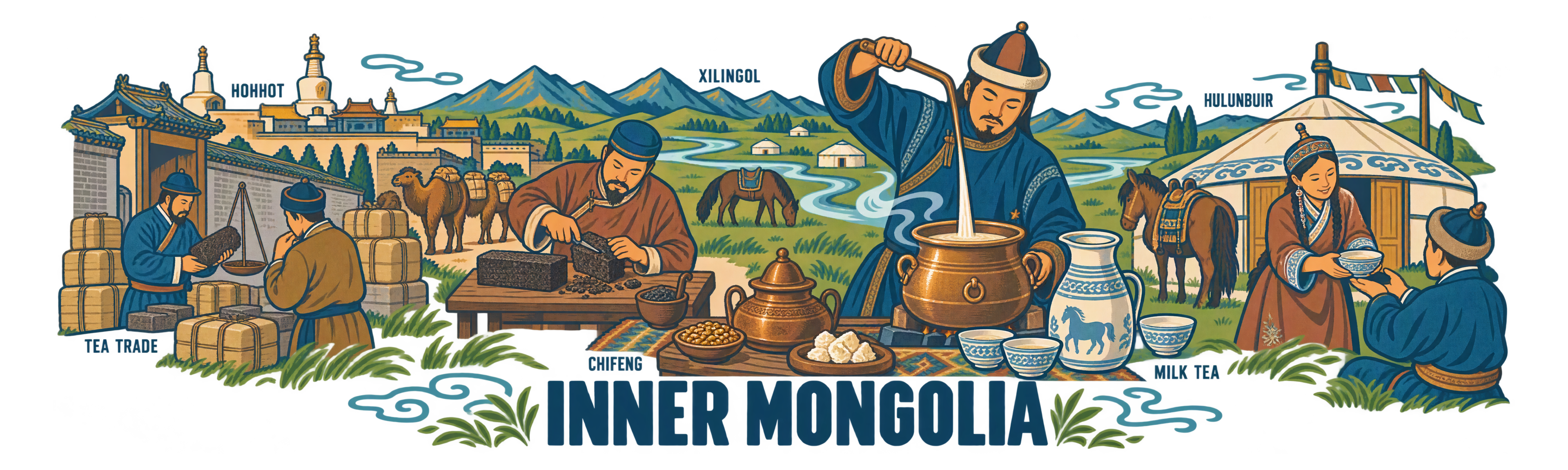
Связный путь привозного чая: торговый двор, подготовка кирпича, молоко, подача гостю.
Проверено для публикации · Просмотр рисунка и техническая проверка текущего файла
Региональное исследование и источники
Основание проверки
Просмотрена ясная связная сцена: чайная торговля Hohhot, подготовка кирпича, котёл, молоко и гостеприимство степи. Название и подписи читаются; контуры резкие, края целые, прозрачные просветы сохранены. Нет местной чайной плантации.
PNG RGBA 3840 × 1152 px; настоящий альфа-канал; пропорциональный экспорт 250 × 75 мм.
Допущен после просмотра для открытой галереи; не означает утверждение пользователем промышленного тиража.
Палитра авторского задания
#204D6D
#BE923B
#7B984A
#B06E54
#79A5AD
Точное текстовое задание
Текст совпадает с публичным TXT. Перечень надписей и деталей описывает авторское задание; это не OCR и не обещание воспроизводимости без использованных референсов.
SHA-256: f9f913c794e7002fe835690084cdc03059654466fac8b5876abba5842e4cda8c
Прочитать полный промпт
Create one exceptional, completely flat regional ceramic-print artwork. This is the actual printable illustration, never a cup, product photograph, mockup, presentation board or simulated ceramic surface. The collection reference controls drawing language only: invent a new composition for the specified region and replace all Guangdong-specific objects. The source map supplies a regional inventory, not a paper texture or a layout to trace literally.

TECHNICAL CONTRACT: native canvas exactly 3840 x 1280 pixels, true RGBA PNG. Keep every visible mark, letter, ornament and antialiased edge inside x=60..3780 and y=110..1170. The final delivery will use a centered 3840 x 1152 export for a 250 x 75 mm wrap; leave the native safety area completely transparent. Compose for a long horizontal physical print, not a conventional poster. Nothing is cut off at either end. All exterior space and meaningful holes between objects must have alpha zero. No painted background, white underpainting, sky rectangle, tinted paper, land silhouette, colour fog, opaque backdrop or checkerboard. The wearer-visible ceramic supplies the unprinted space. Use the specified colours as ink, with normal edge antialiasing; do not invent extra white, black or metallic ink. Never print dimensions, crop marks, palette swatches, filenames, reference names or instructions.

ART DIRECTION: create a memorable hierarchy, a major focal scene and a quieter counterweight; alternate large close forms with medium stories and a few small discoveries. Let tea life interact with the region. Connect selected objects through a real roofline, tabletop, lane, ridge or river contour; retain clear breathing channels so each gesture and vessel is legible. Do not impose any percentage of empty space. Avoid both a cramped rectangular carpet and timid isolated stickers. Use confident, intentional linework that will survive the 75 mm print height. Limit texture to useful material clues. Any water, snow, steam or clouds are sparse outlines with transparent interiors, never washed fills. No photographic gradients, glow, heavy grunge, blurred edges or tiny illegible hatch fields.

FACTUAL DISCIPLINE: the scenes below distinguish cultivation, processing, trade, hospitality and non-tea infusions. Do not turn imported tea, berries, ginseng, barley, trees or grasslands into tea plantations. Do not invent a local tea cultivar, a named historic tea shop, medical effects, a precise trade route or archaeological evidence. Landmarks are cultural/geographic motifs, not assertions that tea was grown or traded at their gates. A contemporary tea pause next to a landmark is an authored scene, not a documentary historical claim. Keep people natural and respectful, with plausible hands and gestures; use no decorative pseudo-script.


C3: LIVING TEA TERRITORIES. Make an oblique, connected illustrated tea world, held together by a locally meaningful river, street, mountain fold or caravan corridor. Large foreground hospitality or craft overlaps medium buildings and small distant geography. Five flat inks, expressive editorial drawing and carefully observed vessels. No administrative outline, amusement-park badge grid or generic ornamental tea leaves. Integrate a strong condensed regional heading in the lower rhythm, not in a separate title band.

REGION: Inner Mongolia. Exact ink palette: #204D6D, #BE923B, #7B984A, #B06E54, #79A5AD. The first colour supplies the main line; the others have deliberate separate roles, not gradients.

AUTHENTIC SUBJECT MATTER:
Inner Mongolia is a region of imported brick tea, skilled milk-tea preparation and hospitality, not tea plantations. Make six distinct actions visible: a Hulunbuir host offers a bowl at a yurt doorway; a Xilingol maker lifts tea with a long ladle over a round pot; a plain compressed tea brick is broken into a scoop beside a small brewing vessel; fresh milk is added from a jug after the tea is brewed and strained; a Chifeng copper-pot serving has a small roasted-grain dish and a few curd pieces; a Hohhot/old Guihua merchant courtyard holds wrapped tea bundles, a balance and two people assessing the delivered tea. Keep the brick, ladle, jug and bowl different in silhouette and actual scale. The recipe is one plausible regional variant, never a claim of compulsory ingredients or exactly three greeting cups. A short grassland contour and one horse give the domestic tea actions a pastoral setting. Camel loads in the trading section represent transport generally without printing exchange rates or invented historic shop names. Tea bushes must not appear among grass, poplars or dairy animals.

SPECIFIC COMPOSITION:
Build a flowing chain from a small Hohhot trading courtyard at the left, through a brick-breaking preparation bench in the center, to a large Xilingol milk-tea maker and Hulunbuir host at the right. The important transition is tea arriving, being brewed, meeting milk and being shared. A curving ground edge can connect two locations symbolically, but must not pretend to be a precise historical itinerary. Place a Chifeng copper pot on a lower near-view table as a contrasting vessel. One horse and a yurt provide altitude and scale; grass is only a few open strokes. The title sits low beside the milk jug, balanced against the high ladle arm.

VISIBLE TYPE: exact main title "INNER MONGOLIA" once. Use only these optional small English labels, integrated beside the appropriate scenes and large enough to read: HULUNBUIR, XILINGOL, MILK TEA, CHIFENG, HOHHOT, TEA TRADE. Do not add other text. No Chinese characters, bilingual captions, pseudo-calligraphy, gibberish, slogans, logos or signatures. Prioritize visual storytelling over words. Do not allow letters to merge with foliage or buildings. The design must feel like a collectible regional artwork that a tea professional would want to handle and study.