Цзилинь / JL_C5
Цзилинь — Парад достопримечательностей
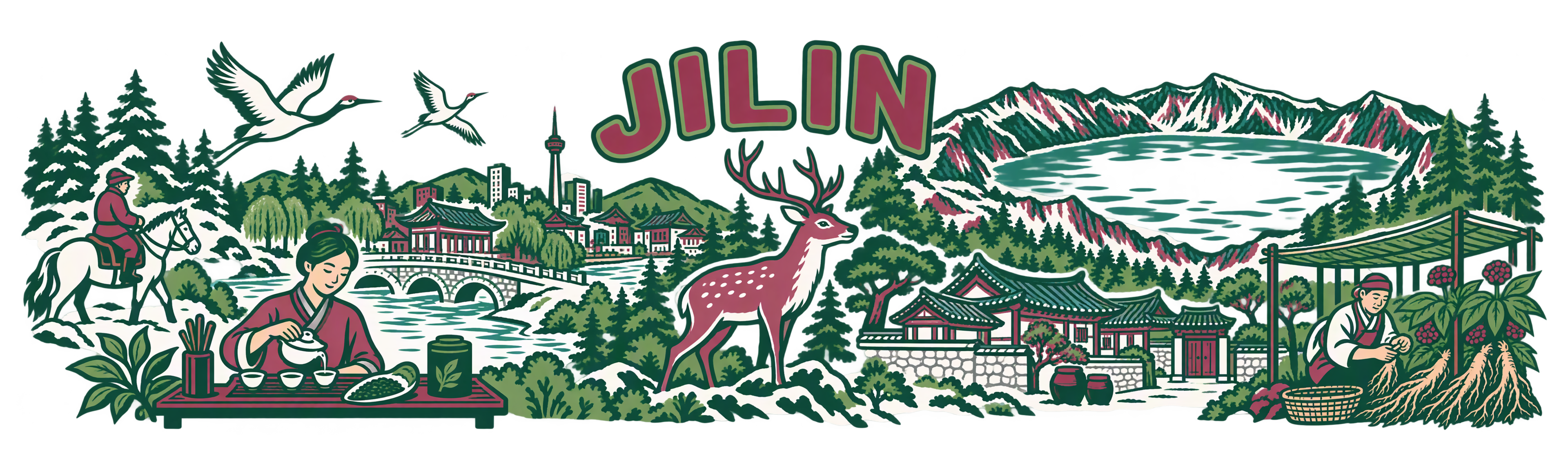
Контурный парад: гайвань, олень, кратер, двор и журавли.
Проверено для публикации · Просмотр рисунка и техническая проверка текущего файла

Региональное исследование и источники
Основание проверки
В исправленной версии Tianchi показан открытым кратерным озером без прежнего зелёного острова. JILIN целый и читаемый; чистый толстый контур, чайный стол, лес, журавли и отдельный женьшеневый участок сохраняют местную логику. Это художественная композиция, не точная карта.
PNG RGBA 3840 × 1152 px; настоящий альфа-канал; пропорциональный экспорт 250 × 75 мм.
Допущен после просмотра для открытой галереи; не означает утверждение пользователем промышленного тиража.
Палитра авторского задания
#254D43
#A44366
#849E6F
Точное текстовое задание
Текст совпадает с публичным TXT. Перечень надписей и деталей описывает авторское задание; это не OCR и не обещание воспроизводимости без использованных референсов.
SHA-256: e2a56727ceacc933dbc272bc329a30d3cb380d4314f6555f36a7324006eeb31c
Прочитать полный промпт
GEOGRAPHIC CORRECTION: Tianchi is a continuous open crater lake. Its water interior is entirely clear of islands; no central island, garden or green land mass in the lake. Put all green vegetation only on the crater rim outside the water.

PRODUCTION CALIBRATION: use the supplied crisp print illustration as the leading standard for edge clarity, and use any cup photo only for its hand-drawn spirit. Create original local subjects; never reproduce the reference title or region. All strokes and letters must be sharp, complete, readable and deliberately drawn. No painterly blur, soft dirty halos, translucent smearing, duplicated words or pseudo-writing. Every complete object and letter stays 120 pixels inside each native edge. All unpainted exterior and interior openings must be genuine transparent alpha, not an opaque white canvas. Replace any weak fine detail with fewer clear graphic marks.

Create one exceptional, completely flat regional ceramic-print artwork. This is the actual printable illustration, never a cup, product photograph, mockup, presentation board or simulated ceramic surface. The collection reference controls drawing language only: invent a new composition for the specified region and replace all Guangdong-specific objects. The source map supplies a regional inventory, not a paper texture or a layout to trace literally.

TECHNICAL CONTRACT: native canvas exactly 3840 x 1280 pixels, true RGBA PNG. Keep every visible mark, letter, ornament and antialiased edge inside x=60..3780 and y=110..1170. The final delivery will use a centered 3840 x 1152 export for a 250 x 75 mm wrap; leave the native safety area completely transparent. Compose for a long horizontal physical print, not a conventional poster. Nothing is cut off at either end. All exterior space and meaningful holes between objects must have alpha zero. No painted background, white underpainting, sky rectangle, tinted paper, land silhouette, colour fog, opaque backdrop or checkerboard. The wearer-visible ceramic supplies the unprinted space. Use the specified colours as ink, with normal edge antialiasing; do not invent extra white, black or metallic ink. Never print dimensions, crop marks, palette swatches, filenames, reference names or instructions.

ART DIRECTION: create a memorable hierarchy, a major focal scene and a quieter counterweight; alternate large close forms with medium stories and a few small discoveries. Let tea life interact with the region. Connect selected objects through a real roofline, tabletop, lane, ridge or river contour; retain clear breathing channels so each gesture and vessel is legible. Do not impose any percentage of empty space. Avoid both a cramped rectangular carpet and timid isolated stickers. Use confident, intentional linework that will survive the 75 mm print height. Limit texture to useful material clues. Any water, snow, steam or clouds are sparse outlines with transparent interiors, never washed fills. No photographic gradients, glow, heavy grunge, blurred edges or tiny illegible hatch fields.

FACTUAL DISCIPLINE: the scenes below distinguish cultivation, processing, trade, hospitality and non-tea infusions. Do not turn imported tea, berries, ginseng, barley, trees or grasslands into tea plantations. Do not invent a local tea cultivar, a named historic tea shop, medical effects, a precise trade route or archaeological evidence. Landmarks are cultural/geographic motifs, not assertions that tea was grown or traded at their gates. A contemporary tea pause next to a landmark is an authored scene, not a documentary historical claim. Keep people natural and respectful, with plausible hands and gestures; use no decorative pseudo-script.


C5: BOLD FRIENDLY LANDMARK PARADE. Confident rounded pen turns, double-contour regional lettering, reduced architectural silhouettes and a joyful procession of people, local travel motifs, vessels and landmarks. Three flat inks and spare patches of colour. Vary height and scale sharply; objects overlap through useful shared contours rather than being pasted in one equal-sized row. Tea must remain a visible living action in this mixed regional collection. Rounded does not mean infantile, and friendly does not mean generic.

REGION: Jilin. Exact ink palette: #254D43, #A44366, #849E6F. The first colour supplies the main line; the others have deliberate separate roles, not gradients.

AUTHENTIC SUBJECT MATTER:
Use the crater bowl of Tianchi and the sharp Changbai rim as the main natural signature; draw water as open curved strokes. Contrast this with a low Songhua riverside street, a small stone bridge, a Korean-style courtyard roof group at Yanji, and a wooden rural farmhouse. Include one deer, two cranes, a few pines and a compact ginseng cultivation shade frame near Baishan. Ginseng roots are illustrated as roots, never Camellia tea bushes. A single horse and rider may mark the plains at one end. Tonghua can be suggested by a small traditional gateway. The cultural architecture, forest ecology and real tea-service actions make a rich northern story without inventing tea agriculture.

Tea anchors that remain visible: modern tea-art pouring from a gaiwan, imported leaf weighing and tasting, a traveller with tea thermos, and a separately understood ginseng herbal still life.

SPECIFIC COMPOSITION:
A bold gaiwan, cup and leaf scoop lead a cheerful irregular procession into double-contour JILIN. A deer takes one deliberate step past the title, while the compact Tianchi crater rises behind its far end. A broad low Yanji courtyard and a narrow ginseng shade frame create different architectural rhythms. The farmer works roots, the tea practitioner works leaves at a separate table. Two cranes and one rider punctuate the river turn; keep them fewer and larger than confetti icons. Pine trunks remain open and simple. Use the green and berry accents to separate real tea action from the botanical-root discovery.

VISIBLE TYPE: exact main title "JILIN" once. The regional title is the only printed text. Do not add small location labels. No Chinese characters, bilingual captions, pseudo-calligraphy, gibberish, slogans, logos or signatures. Prioritize visual storytelling over words. Do not allow letters to merge with foliage or buildings. The design must feel like a collectible regional artwork that a tea professional would want to handle and study.