Tibet / XZ_C7
Tibet — Based on real cups
Ten large episodes in the manner of real cups; three confirmed tea districts are not lost among mountain symbols.
Checked for publication · Drawing review and technical check of the current file
C7: drawing method and real style references
Factual basis and choice of subjects
Ten large episodes in the manner of real cups; three confirmed tea districts are not lost among mountain symbols.
Title and drawing language
The assignment provides for only one word — TIBET, in large Latin serif letters. Small place names, Chinese text, numbers and third-party logos are excluded. This is a description of the assignment; actual readability is assessed separately.
Drawing method and style references
Photographs of real tourist mugs with city scenes of Guangzhou, Macau, Hong Kong and Zhuhai were studied. From them, observed drawing features were taken: medium lively hand outline, simple recognizable silhouettes, selective flat color accents and a large title in the upper band. The specific set of viewed angles varied by region.
Local scenes vary in scale, shape, and height. Their juxtaposition creates an overall rhythm; a continuous panorama, a shared horizon, a grid of identical modules, and a fixed percentage of empty space are not imposed. Transparency is preserved between and within outlines.
The ceramic surface, highlights, hands, and the object background of the photographs are not part of the new drawing. Reference images and personal source photos are not published here. The three colors of each region are the author's palette, not a measured paint standard of the photographed cup.
Review basis
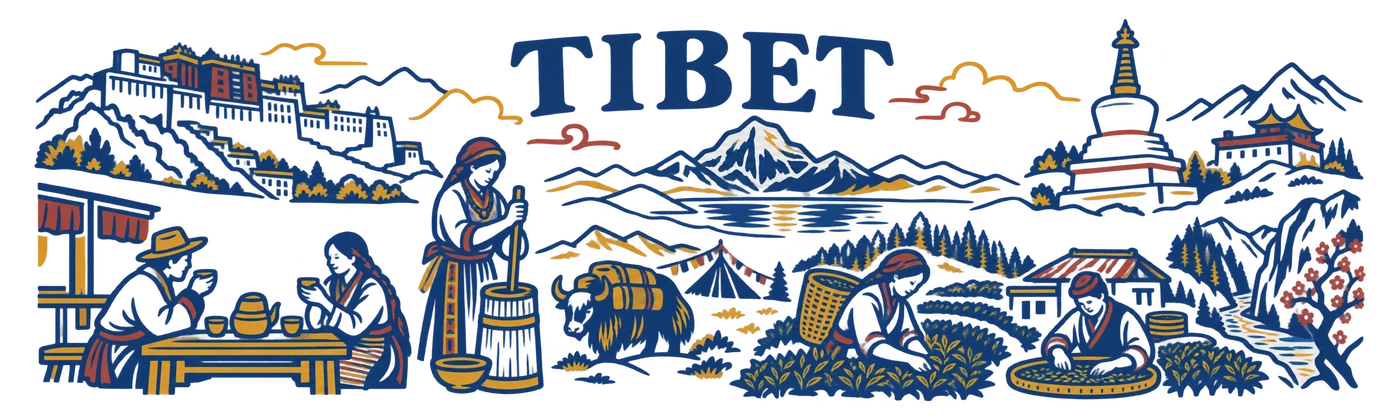
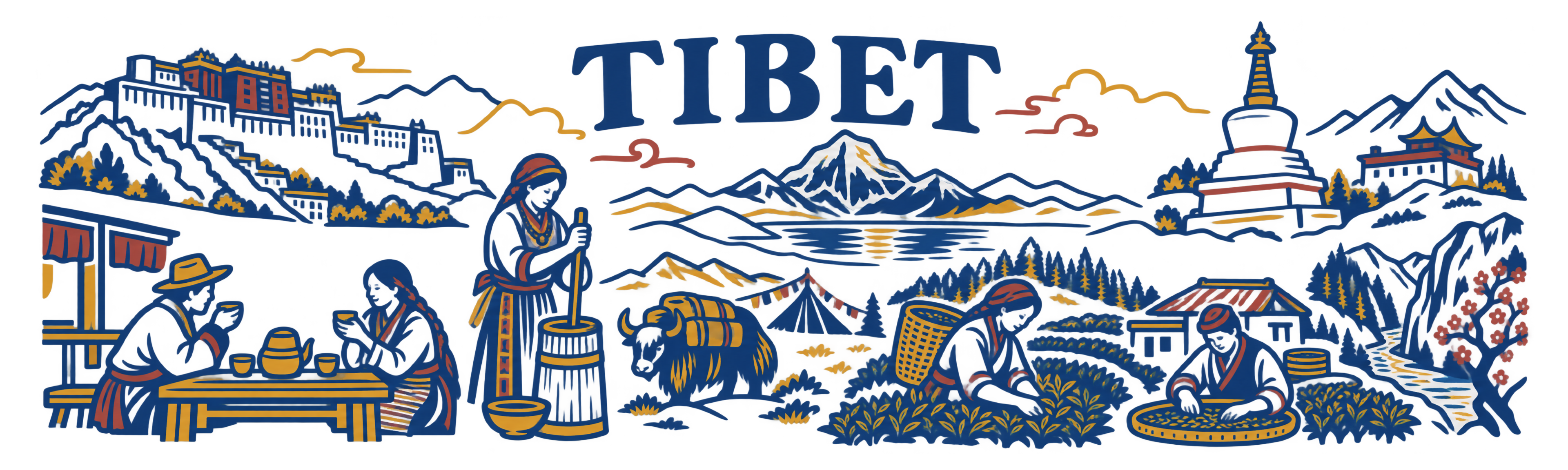
Reference-like medium contour souvenir illustration with selective blue/gold/russet fills and only TIBET text. Palace, lake, stupa, urban tea table, butter-tea churn, yak and separate lush picking/processing scenes read clearly. Large irregular groups and transparent openings retain print clarity without fog or microtext.
PNG RGBA 3840 × 1152 px; real alpha channel; proportional export 250 × 75 mm.
Approved after review for the open gallery; does not imply the user's endorsement of industrial production.
Creative brief palette
#24477D
#D6A135
#A34B43
Original generation prompt
Text matches the public TXT. The list of inscriptions and details describes the author's brief; this is not OCR and not a promise of reproducibility without the references used.
SHA-256: d733fc62011086fa5602d6d0a76ee31b82373f280a5e9f63034927be8ab61b3f
Read the full prompt
RENDERING REQUIREMENTS: Produce a new, completely crisp region-specific illustration. Borrow ONLY drawing style from the references; do not copy their region, title or place names. Use the exact region and English lettering in the brief. No blurred patches, mist, smoky shading, translucent brush smears or soft-focus architectural details. No clipping of objects or letters: keep an 80-pixel clear safety margin around the complete composition. True PNG RGBA transparency between the drawn shapes; no opaque white or coloured backing. Sharp ink edges, legible deliberate lettering.

RENDERING REQUIREMENTS: Produce a new, completely crisp region-specific illustration. Borrow ONLY drawing style from the references; do not copy their region, title or place names. Use the exact region and English lettering in the brief. No blurred patches, mist, smoky shading, translucent brush smears or soft-focus architectural details. No clipping of objects or letters: keep an 80-pixel clear safety margin around the complete composition. True PNG RGBA transparency between the drawn shapes; no opaque white or coloured backing. Sharp ink edges, legible deliberate lettering.

Create an original flat souvenir-cup decal, not a mug mockup or a photographed product. Follow the approved real-cup outline style with simple shapes and restrained accents. Do not reproduce the source map's parchment, dense relief shading or filled scenery. Native canvas 3840 x 1280 pixels, actual RGBA PNG, with every mark safely inside x60..3780/y110..1170; final centered export is 3840 x 1152 for 250 x 75 mm. Keep all canvas margins alpha zero. No visible frame or printed technical information.

Use confident, slightly human 5–7 px outlines, readable at 75 mm print height. Most object bodies are open alpha-zero interiors: the ceramic itself becomes the unprinted colour. Only small, sharply bounded flat accent patches; no white or cream backing, no sky/ground slab, no brown wash, watercolor, airbrush, photographic texture, dense engraving or crosshatching. Use 3–5 short interior marks for an ordinary vessel or object, a few essential openings for a building. Tea steam is at most one or two open curls. No global ground line connecting every scene.

Arrange 8–10 substantial, unequal episodes in a lively irregular field. Put the largest episode off-center, let a tall narrow object answer it, and fit a few smaller ones into purposeful gaps. Different heights and natural overlaps are welcome, but every episode needs a legible silhouette and a clean breathing channel. No fixed whitespace percentage, no equal two-row sticker grid, no miniatures scattered under an enormous empty heading. Preserve real regional identity through observed objects and explicit tea actions. Never invent tea farms or label herbs as tea leaves. Architecture is a geographic motif; contemporary tea pauses are authored scenes, not historical evidence.


C7: REAL SOUVENIR-CUP PEN DRAWING. Match the approved Xinjiang and Shanghai cup illustrations through warm, assured medium outlines and selective small flat accents. At native size use approximately 5–7 px main strokes and only 3–5 interior strokes per simple object. Larger buildings may have a few more essential windows, never dense hatching. Most enclosed bodies remain transparent. Draw 8–10 unequal, generous subject groups at different heights, with irregular open channels between them. This is neither an evenly spaced icon grid nor a tightly packed panoramic painting. No watercolor, sepia haze, opaque cream objects, stippled shading or engraving.

REGION: Tibet. Palette: #24477D, #D6A135, #A34B43. First colour is the main outline; remaining two are small flat accents. No additional inks.

Draw TEN unequal generous episodes: (1) a Lhasa sweet-teahouse table with two seated guests, a kettle and two plain cups; (2) a pastoral host beside a wooden butter-tea churn and bowl, the tallest tea gesture; (3) a Yigong/Bomi picker, fresh-leaf basket and two curved tea rows beneath a wooded hill; (4) a distinct Medog steep tea garden with a broad gathering basket and one simple processing tray; (5) a Zayu leaf-sorting bench, small workshop roof and two tea shrubs; (6) a pack yak with plain compressed-tea bundles beside a small dry ridge and tent; (7) a compact stepped Potala silhouette; (8) the angular Kailash peak with an open Manasarovar lake curve; (9) one Gyantse stupa answered by a small Shigatse roof; (10) a Nyingchi river gorge, steep peak and one peach-blossom branch. Keep the three growing scenes together on the humid side, never under Kailash or the dry yak ridge. The guest table and picker are unequal wide anchors, with churn and stupa as narrow counters. Deep blue is the clean main line; ochre and muted red appear only in small roof, vessel and flower accents. Do not cover mountains or tea gardens in washes. No Tibetan, Chinese or small English location labels, no flags with pseudo-script. Every object remains a simple large contour drawing with sparse interior marks.

PRINTED TEXT: exactly "TIBET" once, near the upper composition, in warm hand-drawn block-serif capitals. This is the only visible text: no place names, subheadings, numbers, Chinese, labels, logos or signatures. Keep the word readable and scaled to the drawing, not an oversized empty banner. Preserve the anatomy and silhouette of local animals and vessels; do not repeat or multiply episodes to fill gaps. Deliver the drawing itself on genuine transparency.