Henan / HA_C1
Henan — Maojian in the master's hands
Large hands and fine leaves reveal southern Henan tea.
Checked for publication · Drawing review and technical check of the current file
Review basis
Retry: foggy texture removed. HENAN and all five tea captions are legible, hands and trays are clear, hatching is intentional; main objects have finished outlines.
PNG RGBA 3840 × 1152 px; real alpha channel; proportional export 250 × 75 mm.
Approved after review for the open gallery; does not imply the user's endorsement of industrial production.
Creative brief palette
#584F2C
#B66B3A
Original generation prompt
Text matches the public TXT. The list of inscriptions and details describes the author's brief; this is not OCR and not a promise of reproducibility without the references used.
SHA-256: a6aeb50f1ed17f6c322c917b79b8def921267b022512e2b4190fccc895cd0274
Read the full prompt
RENDERING REQUIREMENTS: Produce a new, completely crisp region-specific illustration. Borrow ONLY drawing style from the references; do not copy their region, title or place names. Use the exact region and English lettering in the brief. No blurred patches, mist, smoky shading, translucent brush smears or soft-focus architectural details. No clipping of objects or letters: keep an 80-pixel clear safety margin around the complete composition. True PNG RGBA transparency between the drawn shapes; no opaque white or coloured backing. Sharp ink edges, legible deliberate lettering.

PRODUCTION CALIBRATION: use the supplied crisp print illustration as the leading standard for edge clarity, and use any cup photo only for its hand-drawn spirit. Create original local subjects; never reproduce the reference title or region. All strokes and letters must be sharp, complete, readable and deliberately drawn. No painterly blur, soft dirty halos, translucent smearing, duplicated words or pseudo-writing. Every complete object and letter stays 120 pixels inside each native edge. All unpainted exterior and interior openings must be genuine transparent alpha, not an opaque white canvas. Replace any weak fine detail with fewer clear graphic marks.

Create an exceptional original flat illustration for a collectible tea-region ceramic wrap. The attached image is a STYLE reference, not a content reference: preserve its drawing intelligence, print character and relationship between title, scenes and empty glaze; replace every Guangdong-specific subject and word. Output one panoramic native 3840 x 1280 pixel PNG with a genuine RGBA alpha channel. All artwork, including lettering, must remain wholly inside x60..3780 and y110..1170. The upper and lower outside bands and the external negative space must be transparent, not white paint. The final production crop will be 3840 x 1152 pixels for a 250 x 75 mm wrap; do not draw dimensions, crop marks or a frame. No mug, mockup, photograph, simulated paper, decorative rectangular background, cast shadow, checkerboard or watermark.

DRAWING AND PRINT DISCIPLINE: Use confident authored linework, recognisable local silhouettes, selective flat colour and well-resolved hands, vessels and architecture. Details reward close looking but the main story reads across a small ceramic surface. Colour belongs to actual drawn objects or deliberate bounded accents. Transparent sky, river openings, architectural gaps and open vessel interiors are part of the design. Do not use a continuous opaque landscape base, atmosphere wash, cream substrate or enormous filled silhouette behind everything. Keep deliberate pauses between major masses without making a sticker sheet. Never cut off a letter, roof, person, handle or tree at the image boundary. Do not scatter repeated generic teapots as filler. Each featured tea action must communicate a different part of the region's tea story. This is an illustrated interpretation, not a navigable map: no compass, coordinate grid, dotted connectors, numbered pins, legend or tiny labels.

COLLECTION C1 — ENGRAVED TEA CONSTELLATION.
Two carefully separated spot inks. Organic engraved contours, selective small hatching and beautiful botanical structure, not grey photographic shading. A major tea subject anchors one side while smaller living stories nest into shared terraces, a riverbank or an architectural contour; these threads connect the illustration without enclosing it. A tall narrow serif regional title occupies a clear deliberate pocket. Vary foreground, middle distance and far silhouettes; avoid uniform line density and isolated circular vignettes.

REGION: HENAN. EXACT PALETTE: #584F2C, #B66B3A. Use only these opaque graphic inks and their clean antialiased edges; no white ink, black substitution or extra colours. Transparent negative space is not an additional ink.

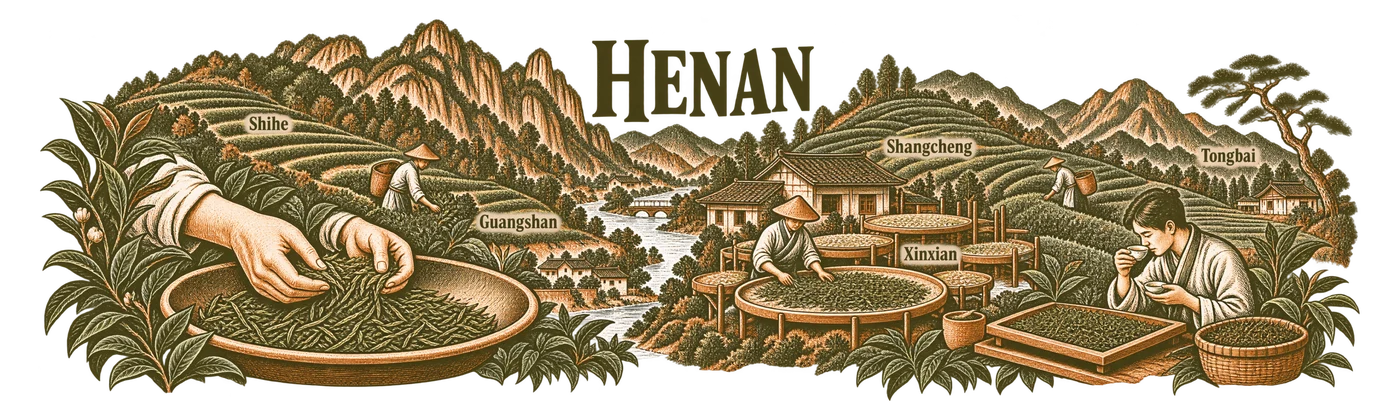
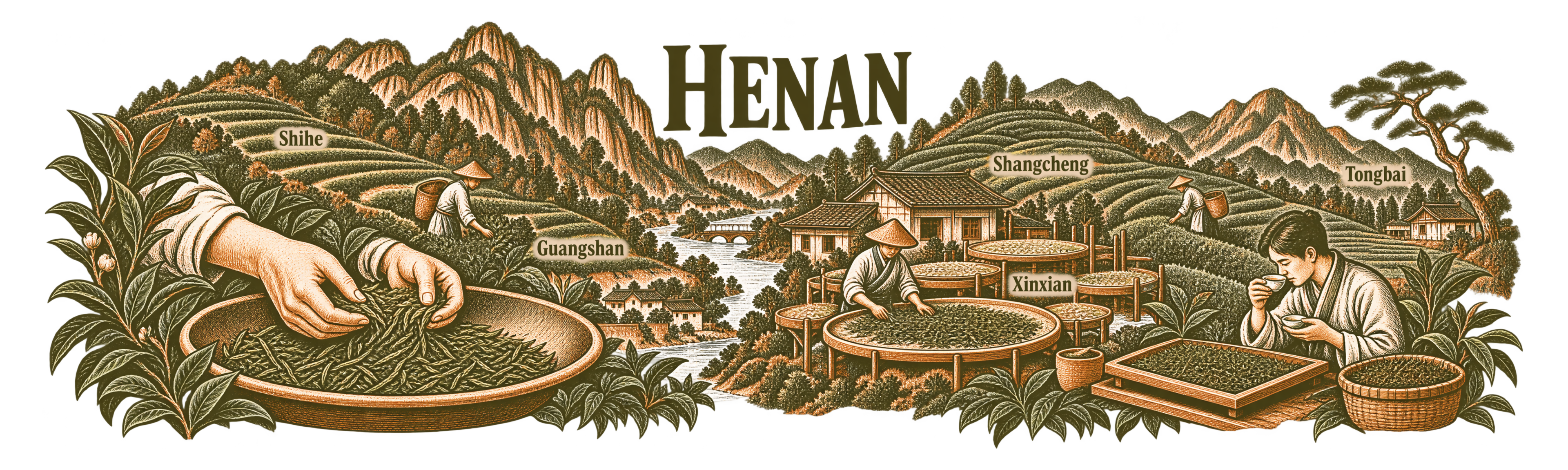
A foreground tea master's two hands gently shape slender Maojian leaves over an open shallow pan, its oval rim the major engraved form. Behind the hands, Shihe mountain tea rows rise into the Dongjiahe hills. A Guangshan picker moves down a side path with a light basket; Shangcheng ridge tea and Xinxian farmhouse drying trays create smaller connected scenes. At far right a Tongbai tea garden and a host examining an infusion complete the cycle. Include a distinct tray of dry pointed leaves rather than repeating a teapot at every locality.

REGIONAL TRUTH: Henan tea production is concentrated in its southern hills. Xinyang Maojian is a fine green tea, with Shihe a core district and the Dongjiahe tea mountains an established origin. Its craft includes spreading, pan fixation/rolling, shaping and drying. Guangshan, Shangcheng and Xinxian are real tea-producing areas in the wider Xinyang region; Tongbai is a distinct southern Henan tea area. Xinyang Hong is black tea, not the same processing as Maojian. Never place tea plantations across the northern Yellow River plain or grow tea among the Longmen carvings. Shaolin, Kaifeng and Luoyang are cultural travel motifs, not asserted tea estates.

SPECIFIC COMPOSITION: The pan is large and low, counterbalanced by tall finely engraved tea shoots left of the title. Pan rim, garden contour and farmhouse eave establish a shared curved movement. Keep clear spaces between fingers and between hill layers. The regional title sits above the quiet central valley.

TEXT: Main title exactly "HENAN". Secondary labels, each once and attached to its correct scene: Shihe; Guangshan; Shangcheng; Xinxian; Tongbai. No other text.

FINAL ART DIRECTION: Make every major group different in scale and gesture. Do not give every scene a surrounding halo or a separate base. A viewer should discover a clear regional idea at arm's length and then human actions, leaf shapes and local building features nearby. Keep the specified palette visible as actual graphic inks, not merely a tint over green scenery. Do not add unrequested slogans, stamps, logos, dates, Chinese characters or gibberish. The exact allowed English words below are the entire text vocabulary. Keep secondary words comfortably readable if allowed; omit a minor caption rather than shrinking it to microscopic lettering. Render the regional title exactly once and complete, with comfortable space around it. No extra title repeated on vessels or buildings. Draw a finished cohesive piece of print art, never a presentation board.